Murder, Corruption and RICO in Georgia: Fateful meeting I didn't want to attend led to courtroom win


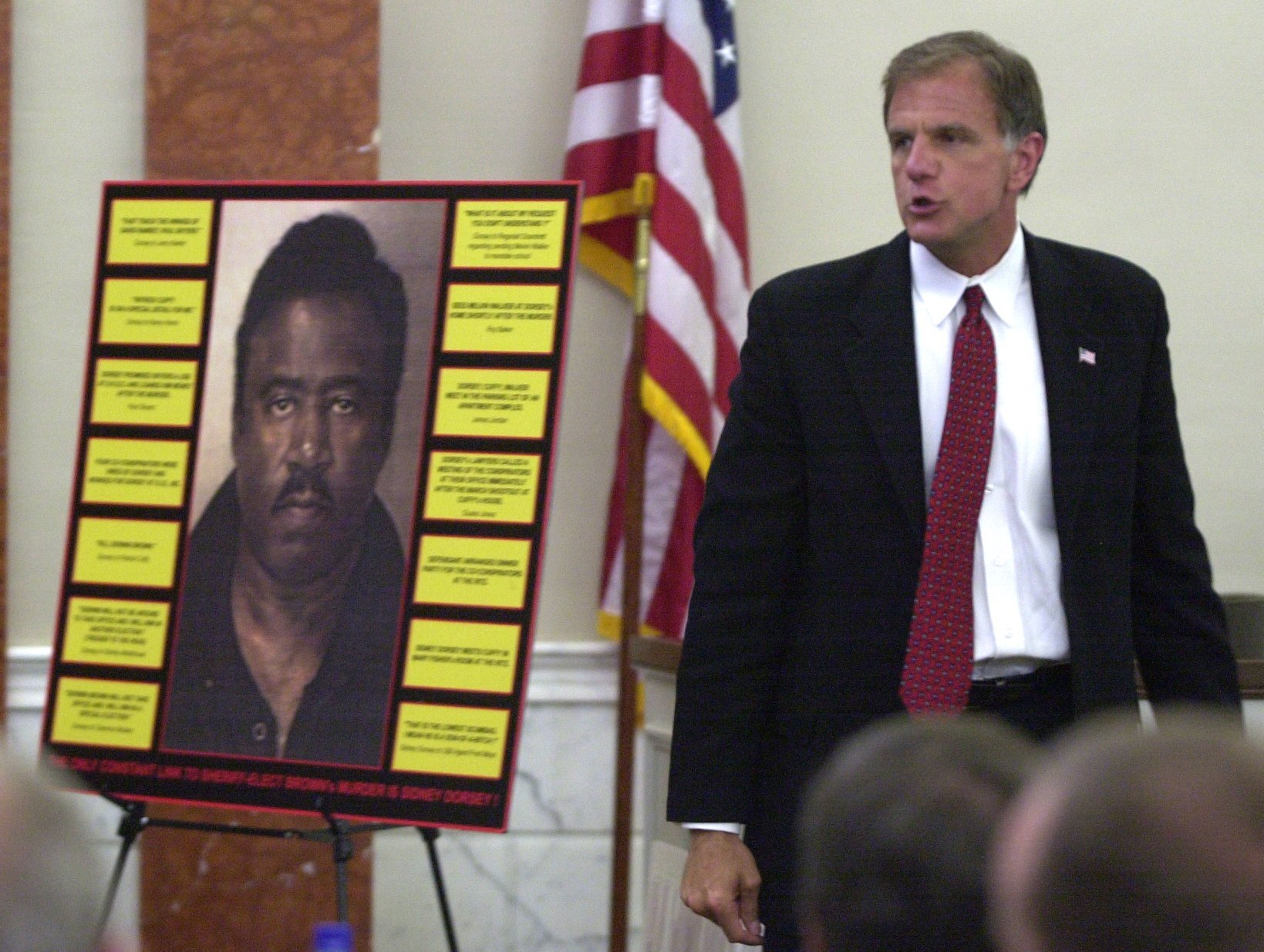
In 2002, J. Tom Morgan, then-DeKalb County district attorney, used a chart during closing arguments to list the chain of events that led from racketeering to murder by defendant Sidney Dorsey. (AP Photo/Atlanta Journal-Constitution, Renee’ Hannans)
Never did I imagine that a murder case I prosecuted with many twists and turns—including a death threat against me—would lead to the use of a novel legal theory.
On Dec. 15, 2000, Derwin Brown, the sheriff-elect of DeKalb County, Georgia (then Georgia’s second-largest county), was assassinated in his driveway on a rainy night three days before he was to be sworn into office. His family was waiting for him to enter the front door when 12 bullets ripped through the lawman’s body.
Devastatingly, no evidence of the killer was left behind.
The preceding summer, Brown had surprisingly defeated the charismatic incumbent sheriff, Sidney Dorsey. Leading to Dorsey’s downfall were several shocking stories detailing corruption in the sheriff’s department reported during the campaign by investigative journalist Dale Cardwell of the ABC affiliate WSB-TV.
These exposés included sheriff’s deputies working security for Dorsey’s private security firm while on the county clock; sexual harassment; and use of inmates to perform personal tasks, such as painting and landscaping, at private residences. These residences happened to be located in the political jurisdiction of Sherry Dorsey, who was an elected member of the Atlanta City Council and the wife of then-Sheriff Dorsey.
At the request of me, the elected district attorney of DeKalb County, the superior court judges empaneled two special investigative grand juries: one tasked with the investigation of the alleged corruption inside the DeKalb County Sheriff’s Department, and the other tasked with the investigation of the murder of Sheriff-elect Brown. At the time, we did not have any suspects and did not know whether the investigations would be related.
 J. Tom Morgan (Photo by Caroline Berchuck)
The grand juries heard evidence for 10 months, from February through November 2001.
The testimony of corruption, inside dealing, theft of services and bribery was far greater than we could have conceived.
The murder grand jury investigation, on the other hand, was stymied without any viable suspects until we had a surprising break in the case. One of the co-conspirators in the homicide provided a statement to me and two of my staff members detailing the murder in exchange for immunity. During that conversation, I learned the sheriff had also ordered my assassination.
On Nov. 30, 2001, Dorsey was arrested, along with two others, including one of his former deputies, for the murder of Sheriff-elect Brown.
I sat in my office trying to get my head around how we were going to formally charge Dorsey with both murder and voluminous counts of fraud and corruption, when out of the blue I got a phone call from a civil attorney, Emmet Bondurant. Only 26 when he won his first U.S. Supreme Court case, Emmet was a highly respected attorney in the Atlanta legal community. The firm that includes his name, Bondurant Mixson & Elmore, is known for both its stellar legal work and its commitment to community service and pro bono work.

I only knew Emmet on a personal level through our wives, who were college friends. I wondered why Emmet would be calling me at the office, given his firm did not engage in criminal practice.
Emmet does not mince words.
“J.Tom,” he said, “I see you and your office have a big case on your hands. I think it might behoove you to meet with one of my partners, John Floyd.”
“Emmet,” I said, “I didn’t know your firm did any criminal trial work.”
“We don’t,” he replied. “But John has some ideas that might assist you with your prosecution. I hope you can find time to meet with him.”
“I have some time in the morning,” I told him. “I look forward to hearing what Mr. Floyd has to say.”
That last sentence was a bald-faced lie. The absolute last thing I wanted to do was to meet with a civil attorney who had ideas on how to prosecute a criminal case.”
—Excerpt from A Rainy Night in Georgia (Prometheus/Simon & Schuster, Sept. 15, 2026)
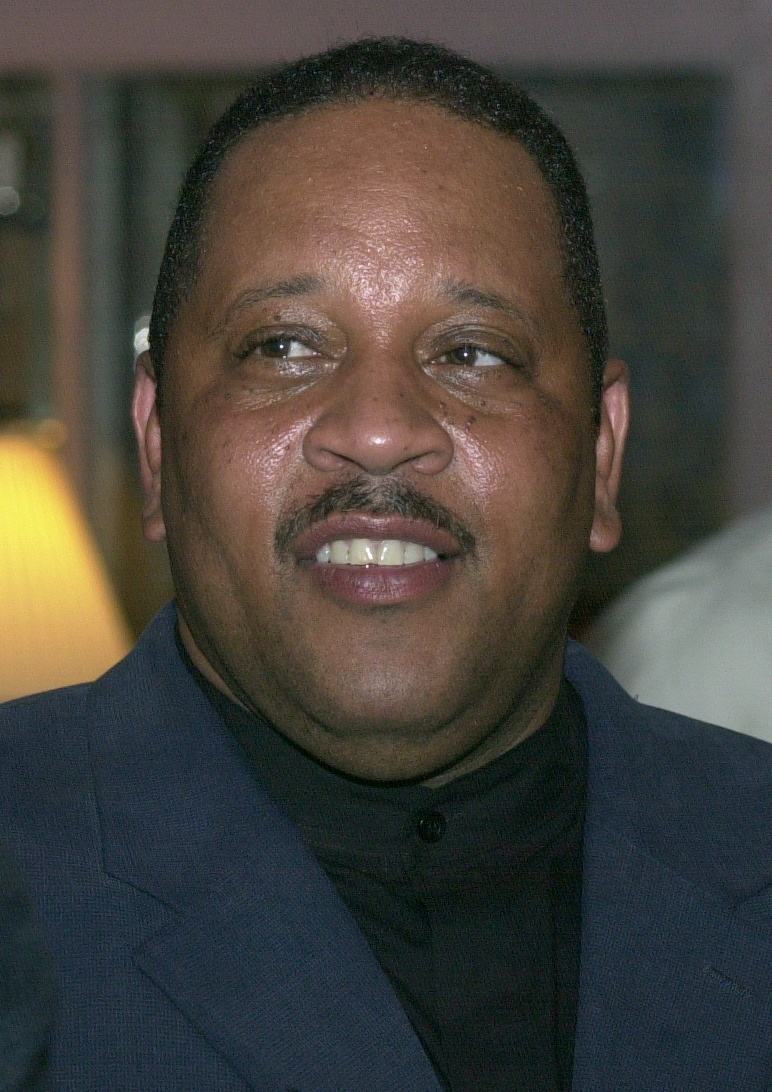 Derwin Brown
The meeting with John Floyd turned out to be a pivotal moment in the prosecution of State of Georgia v. Sidney Dorsey.
Floyd wanted to talk about RICO.
The Racketeer Influenced and Corrupt Organizations Act was passed by Congress during President Richard Nixon’s administration to go after Mafia bosses. States subsequently passed their own versions. I had been a felony prosecutor for almost 20 years and had never heard RICO discussed in a state or national training for state prosecutors. Neither I nor anyone in my office had ever prosecuted a RICO case.
At our meeting, Floyd slowly and patiently explained to my chief assistant, John Petrey, and me why the Georgia RICO statute was tailor-made for prosecuting a corrupt public official. Floyd, who authored RICO State by State: A Guide to Litigation Under the State Racketeering Statutes, was an expert.
He told us that when a prosecutor is faced with charging a defendant with multiple crimes of varying types involving multiple conspirators, a typical indictment listing many counts could be cumbersome for the prosecution and confusing for the jury. Floyd said that combining the various allegations into one criminal charge under RICO would make it easier for the prosecution and the jury to understand.
What Floyd was telling us was starting to make sense, but I was curious why a civil attorney knew so much about a criminal statute. He said there was a civil component to the statute and that he used RICO to file civil complaints. The criminal indictment and the civil complaint were very similar, but with different remedies (conviction vs. damages).
I appreciated Floyd’s insight and advice, but I told him I was reluctant to bring a criminal charge I knew nothing about in the most significant case of my legal career. We were not even sure how to prepare a RICO indictment. Floyd volunteered on a pro bono basis to assist us.
 Sidney Dorsey is seen in court after his arrest.
The beauty of using RICO was that we could combine hundreds of corruption allegations into one count that would have to be proven beyond a reasonable doubt instead of delineating hundreds of separate counts of corruption, each of which would have to be proven beyond a reasonable doubt (we had a separate count for murder).
Our argument was that the overwhelming evidence of corruption provided compelling support for Dorsey’s motivation to kill Brown: He didn’t want to give up his power. We showed evidence during the trial that Dorsey refused to accept the election loss and operated under the delusion that after Brown’s death, the judges would appoint him interim sheriff and that he would win in a special election.
Floyd was sworn in as a special assistant district attorney, and he spent six weeks with us in trial in south Georgia (where the case had been moved due to excessive pretrial publicity). Floyd’s involvement in the trial, albeit outside the jury’s presence, was critical to the prosecution.
After the state had presented all its witnesses, the defense filed a motion to have the RICO count dismissed on the ground that it was never intended to be used against a public official whose crimes occurred while he was in office. Floyd’s argument, coming from a national expert on RICO, convinced the judge that RICO was appropriate under the facts and circumstances in our case.
Our case inspired other state prosecutors to use RICO to fight public corruption. I count my lucky stars that Emmet Bondurant picked up the phone to call me—and was willing to bring John Floyd to our office. And I learned to be open to surprises, even in a meeting I didn’t want to attend.
J.Tom Morgan teaches criminal law and ethics at Western Carolina University. He was District attorney of DeKalb County, Georgia, from 1992-2004. His upcoming book, A Rainy Night in Georgia (released by Prometheus/Simon & Schuster), is about the investigation and prosecution related to the murder of Derwin Brown.
How I Won the Case gives you the inside scoop on big verdicts and trial tactics.
This column reflects the opinions of the author and not necessarily the views of the ABA Journal—or the American Bar Association.