
The 25 Greatest Legal Movies
By Richard Brust


Updated (2018): Our all-time list of cinematic favorites
What would Hollywood do without lawyers? In a town built on copyrights and cosmetic surgery, lawyers have done far more than pen the small print in studio contracts or post bail for hollow-eyed stars on the way to and from rehab. From the incisive Henry Drummond and the droll Mr. Lincoln to the callow Danny Kaffee and the regal Atticus Finch, lawyers have provided some of Hollywood’s most memorable cinematic heroes and some of its most honorable and thoughtful films.
Earlier this year, the ABA Journal asked 12 prominent lawyers who teach film or are connected to the business to choose what they regard as the best movies ever made about lawyers and the law. We’ve collated their various nominees to produce our jury’s top picks.
Together these films represent 31 Oscar wins and another 85 nominations as befits the best work of some of the greatest actors, writers and directors of their time.
So quiet, please. A rap of the gavel, a pull of the curtain, and ‘Hear ye! Hear ye!’ for the 25 greatest law films ever made.
Start slideshow #### 1. TO KILL A MOCKINGBIRD (1962) Gregory Peck lends his legendary dignity to the role of Atticus Finch, Harper Lee’s iconic small-town attorney. Penned for the screen by Horton Foote, the movie was an instant classic, as lawyer Finch rises above the naked racism of Depression-era Alabama to defend a crippled black man (Brock Peters) falsely accused of rape by a lonely, young white woman. Finch’s quiet courage is seen through the eyes of Scout (Mary Badham), his 6-year-old daughter, and embraced by an emerging generation of lawyers as the epitome of both moral certainty and unyielding trust in the rule of law. When the accuser’s drunken, incredulous father glares and asks Atticus, “What kind of man are you?” the unspoken answer is easy: both the self-assured lawyer and upright human being we all hope to be. TRIVIA: THREE Oscar wins. Finch was Lee’s mother’s maiden name. #### 2. 12 ANGRY MEN (1957) Henry Fonda produced and starred in this faithful adaptation of Reginald Rose’s critically acclaimed stage play chronicling the hostile deliberations of a jury in a death penalty case. A lone juror (Fonda) expresses his doubts about what seems at first an open-and-shut prosecution. What tumbles out of the ensuing discussion is a gut-wrenching examination of the prejudices, prejudgments and personal psychological baggage these assembled citizens have brought to a life-or-death debate over the fate of the young Puerto Rican defendant. Based on Rose’s own experience as a juror in a manslaughter trial, the play was first adapted for TV by Sidney Lumet, who went on to direct the movie version, his first feature film. TRIVIA: LOST ALL THREE OSCAR NOMINATIONS TO THE BRIDGE ON THE RIVER KWAI. #### 3. MY COUSIN VINNY (1992) Vincent “Vinny” Gambini (Joe Pesci) is a brash Brooklyn lawyer who only recently managed to pass the bar exam on his sixth try. He’s representing his cousin and a friend—two California-bound college students who are arrested for capital murder after a short stop at a convenience store in rural Alabama. Still, the rule of law prevails in the courtroom of Judge Chamberlain Haller (Fred Gwynne). The movie packs in cinema’s briefest opening argument (“Everything that guy just said is bullshit.”), its best-ever introduction to the rules of criminal procedure, and a case that hinges on properly introduced expert testimony regarding tire marks left by a 1964 Skylark and the optimal boiling time of grits. TRIVIA: MARISA TOMEI WON THE OSCAR FOR BEST SUPPORTING ACTRESS. #### 4. ANATOMY OF A MURDER (1959) Otto Preminger directs this realistic study of an Army lieutenant accused of murdering a bartender who allegedly raped his coquettish wife. An A-list cast is headed by James Stewart as the defense attorney, George C. Scott as prosecutor, Ben Gazzara as the defendant and Lee Remick as his wife. The surprise, though, is the stupendous performance in the role of the judge by real-life lawyer Joseph Welch, who represented the Army in the McCarthy hearings. The plot skips nimbly through a thicket of ethical dilemmas involved in representing a murder defendant. It was inspired by an actual case and adapted from a novel written by a Michigan supreme court judge. The original score is by Duke Ellington, who makes a cameo. TRIVIA: NOMINATED FOR SEVEN OSCARS. LOST FOR BEST PICTURE TO BEN-HUR. #### 5. INHERIT THE WIND (1960) Two grand old lions of the screen, Spencer Tracy and Frederic March, play two grand old lions of the law, Clarence Darrow and William Jennings Bryan, as they grapple in the historic 1925 Scopes “monkey trial” in backwoods Dayton, Tenn. The film, adapted from a 1955 play by Jerome Lawrence and Robert E. Lee, is a fictionalized account, and the characters’ names are changed, however slightly (Tracy’s Darrow is Henry Drummond, and March’s Bryan is Matthew Harrison Brady). But much of the courtroom testimony was taken straight from the trial transcript. Nor have Americans evolved much; 80 years later a federal judge in Pennsylvania was forced to rule on “intelligent design.” TRIVIA: “HE THAT TROUBLETH HIS OWN HOUSE SHALL INHERIT THE WIND.” PROVERBS 11:29 #### 6. WITNESS FOR THE PROSECUTION (1957) The legendary Billy Wilder (Some Like It Hot, The Apartment) directs from a script by the legendary mystery writer Agatha Christie. But it’s the legendary Charles Laughton who fills the screen as the pompous barrister who is supposed to be retired after recovering from an illness but can’t resist taking a puzzling murder case. Real-life wife Elsa Lanchester is his sharp-tongued nurse, and the two sparkle as they verbally spar. Tyrone Power is the playboy defendant; Marlene Dietrich is his wife and, surprisingly, the witness in question. It’s not the only surprise, as befits a Dame Agatha story. Watch for yourself. TRIVIA: NOMINATED FOR SIX OSCARS. DIETRICH WAS CRUSHED NOT TO BE AMONG THOSE NOMINATED. #### 7. BREAKER MORANT (1980) Australian director Bruce Beresford adapts the story of three fellow countrymen who fight for the British Empire in the colonial Boer War in South Africa and are tried and convicted of war crimes. The issues raised in the 1901 guerrilla-war trial echo through decades of 20th century wars: Which orders to follow, which civilians are the enemy, etc. Includes outstanding performances, especially by Edward Woodward and Bryan Brown as the Australian officers and by Jack Thompson as their disheveled defense attorney. TRIVIA: OSCAR-NOMINATED FOR BEST ADAPTED SCREENPLAY. ORDINARY PEOPLE TOOK THE TROPHY. #### 8. PHILADELPHIA (1993) Tom Hanks won an Oscar as an Ivy-educated gay attorney who claims his big-time law firm fired him after discovering he contracted AIDS. The somewhat dated and self-righteous script is saved by Denzel Washington’s vibrant and nuanced performance as the solo personal injury lawyer who takes the case when everyone else turns Hanks’ character down, and who comes to terms with his own homophobia. Bruce Springsteen fans will enjoy the Boss’s Oscar-winning title song. TRIVIA: THAT THE FILM IS “INSPIRED IN PART” BY THE LIFE AND LITIGATION OF GEOFFREY BOWERS, AN ATTORNEY WHO DIED OF AIDS, IS THE RESULT OF A REAL-LIFE LAWSUIT. #### 9. ERIN BROCKOVICH (2000) Julia Roberts does an Academy Award-winning turn as the real-life paralegal and sassy single mom whose dogged investigation into a suspicious real estate case turns up a pattern of illegal dumping of highly toxic hexavalent chromium and one of the heftiest class action suits in U.S. history. Albert Finney portrays her boss, Ed Masry. Lawyer line of the movie, she to him: “Do they teach lawyers to apologize? ’Cause you suck at it.” TRIVIA: THE REAL BROCKOVICH AND THE REAL MASRY MAKE CAMEO APPEARANCES IN A RESTAURANT. #### 10. THE VERDICT (1982) Paul Newman is a washed-up, alcoholic lawyer who gets handed a medical-malpractice case and sees it as one last chance to get his career right. James Mason is diabolical as his courtroom opponent who cavorts with the judge, played by Milo O’Shea. Charlotte Rampling is the love interest—whose interests may not be those of Newman’s character. Tight and tense direction by Sidney Lumet (12 Angry Men, Dog Day Afternoon). TRIVIA: NOMINATED FOR FIVE OSCARS IN THE YEAR OF GANDHI. #### 11. PRESUMED INNOCENT (1990) Lawyer-novelist Scott Turow’s best-seller features Harrison Ford as Rusty Sabich, a top-notch prosecutor who finds himself accused of murdering a colleague with whom he’s had an affair. Through his lawyer, Sandy Stern (Raul Julia), Sabich discovers the seamy side of himself and the criminal law—a view that both offends and saves him. The well-constructed plot includes a dark twist at the end that Sabich will have to learn to live with. TRIVIA: PRODUCED BY ALAN J. PAKULA, WHO EARLY IN HIS CAREER PRODUCED TO KILL A MOCKINGBIRD. #### 12. JUDGMENT AT NUREMBERG (1961) Stanley Kramer directed this searing portrayal of the Nazi war crimes trials set in 1948. The Abby Mann script focuses, in particular, on charges brought against four German judges who are accused of allowing their courts to become accomplices to Nazi atrocities. An American judge, Dan Haywood (Spencer Tracy), finds himself trying to understand how these once-esteemed colleagues allowed themselves to be used. He gets little or no help from average Germans, who are busy distancing themselves from Germany’s Nazi past. When one of the judges, Ernst Janning (Burt Lancaster), breaks from the others and confesses, it becomes clear that—whatever their original intentions—these judges have chosen political obligations over their personal senses of right and wrong. TRIVIA: WON TWO OSCARS. MARLENE DIETRICH, WHO PERSONALLY EXPERIENCED THE NAZI REGIME, WAS ALLOWED TO WRITE MANY OF HER OWN LINES. #### 13. A MAN FOR ALL SEASONS (1966) Paul Scofield’s Oscar-winning performance as Sir Thomas More, the Tudor-era judge made chancellor of England. He is caught in the political struggle involving Henry VIII’s decision to defy the Roman Catholic Church and divorce his wife to wed Anne Boleyn. Lines from playwright Robert Bolt’s stirring script are frequently quoted in U.S. court opinions: “I know what’s legal, not what’s right. And I’ll stick to what’s legal.” And: “This country is planted thick with laws, from coast to coast—man’s laws, not God’s! And if you cut them down, and you’re just the man to do it, do you really think you could stand upright in the winds that would blow then?” TRIVIA: WON SIX OSCARS, INCLUDING BEST PICTURE AND BEST DIRECTOR (FRED ZINNEMANN). #### 14. A FEW GOOD MEN (1992) Say what you will about Tom Cruise, but he is high-octane as a reluctant Navy JAG litigator in Rob Reiner’s suspenseful film iteration of this military courtroom drama by Aaron Sorkin (creator of The West Wing). Two low-ranking Marines from the Guantanamo Bay naval base are being court-martialed for the death of another, allegedly part of an unofficial punishment known as a “code red.” The Marines say they were following orders. Their unapologetic commander, Col. Nathan Jessep (an absolutely electric Jack Nicholson) says they acted on their own. The truth, if you can handle it, turns out to be something more complicated than a sense of duty—but sometimes, exactly that. TRIVIA: SORKIN BASED HIS ORIGINAL PLAY ON A MILITARY CASE PROSECUTED BY DAVID IGLESIAS, LATER U.S. ATTORNEY FOR NEW MEXICO. #### 15. CHICAGO (2002) Lawyers tap-dance all the time, but Richard Gere does so pretty darn well as sleazeball attorney Billy Flynn in the film adaptation of the highly successful Bob Fosse musical. Catherine Zeta-Jones and Renee Zellweger play celebrity murderers who cynically parlay their Jazz Age notoriety into a vaudeville act. Maurine Dallas Watkins’ original play, Chicago, or Play Ball, produced as a silent film by Cecil B. DeMille in 1927 (and later, the 1942 Ginger Rogers vehicle Roxie Hart), is based on two actual murder trials she covered as a reporter for the Chicago Tribune. TRIVIA: WON SIX OSCARS. IN THE ORIGINAL BROADWAY PRODUCTION, FLYNN WAS PLAYED BY THE LATE JERRY ORBACH OF LAW & ORDER TV FAME. #### 16. KRAMER VS. KRAMER (1979) Dustin Hoffman and Meryl Streep both won Oscars as Ted and Joanna Kramer, an estranged couple fighting over custody of their son. Ted deals with real fatherhood for the first time as a single dad when Joanna leaves him. But he must also face his own failures when Joanna resurfaces demanding to gain custody of their son. An all-too-painful reminder of the human toll that is possible when domestic relations litigation takes a nasty turn. TRIVIA: WON FIVE OSCARS. FOR SOME OF THE MOST COMPLEX SCENES, HOFFMAN LEANED ON HIS OWN RECENT EXPERIENCE WITH DIVORCE. #### 17. THE PAPER CHASE (1973) James T. Hart (Timothy Bottoms) is a first-year law student desperately seeking the approval of Harvard’s sternest professor, Charles W. Kingsfield Jr. (John Houseman). He begins to get the respect that he’s earned, only to discover that the young woman he’s involved with (Lindsay Wagner) is the professor’s daughter. The real drama, however, is the demanding milieu of Harvard Law School, where reputations can be made and broken in a single, grueling class. TRIVIA: HOUSEMAN REPRISED HIS OSCAR-WINNING ROLE AS KINGSFIELD FOR FOUR SEASONS ON TELEVISION. #### 18. REVERSAL OF FORTUNE (1990) Before there was an O.J. to help confuse us about the difference between innocent and not guilty, there was Claus von Bulow. Jeremy Irons won an Oscar for his portrayal of the feckless von Bulow, crassly dependent husband of Newport, R.I., socialite Sunny von Bulow, who lapsed into a coma when she was allegedly injected with an overdose of insulin. Tried and convicted of attempted murder in 1982, largely on privately gathered evidence, von Bulow hires Alan Dershowitz, the now ubiquitous Harvard law professor, whose account of the case is the basis for this movie. The law line of the movie occurs when von Bulow is attempting to explain to Dershowitz (Ron Silver) what actually happened: “No,” shrugs Dershowitz. “Never let defendants explain; puts most of them in an awkward position.” “How do you mean?” asks von Bulow. “Lying,” says Dershowitz. TRIVIA: DERSHOWITZ APPEARS IN CAMEO AS A JUDGE ON THE APPELLATE COURT. #### 19. COMPULSION (1959) In 1924, Chicago is rocked by a spectacular murder, apparently committed by two brilliant teenagers from wealthy families who have sought to plot and execute the perfect crime. An aging legendary lawyer, Jonathan Wilk (Orson Welles), is hired to defend the young men with the modest hope of sparing them from the gallows. The film is based on Clarence Darrow’s actual defense of Nathan Leopold and Richard Loeb, director Richard Fleischer turns the sordid details of their vicious crime into a passionate attack on the death penalty. TRIVIA: WHEN STUDIO PUBLICISTS ADVERTISED THE FILM’S CONNECTION TO THE LEOPOLD AND LOEB CASE, LEOPOLD SUED FOR INVASION OF PRIVACY. HE LOST. #### 20. AND JUSTICE FOR ALL (1979) An angry Al Pacino (is there any other kind?) plays Arthur Kirkland, the very best lawyer he knows in Baltimore. His client is losing his marbles; his girlfriend is losing her patience; the senior judge plots suicidal fantasies. Moreover, he is trapped into representing a judge accused of rape—a judge who is gleefully ignoring the incarceration of a very innocent and distressed Kirkland client. All of this is thrown together in a final courtroom harangue that makes Pacino’s bank robber mugging in Dog Day Afternoon sound like Trappist prayer. You think I’m outta order? Hey, courtroom or not, it’s Pacino. TRIVIA: JACK WARDEN, WHO PLAYS A SUICIDAL JUDGE, APPEARS IN TWO OTHER FILMS ON THE ABA JOURNAL’S TOP 25, 12 ANGRY MEN AND THE VERDICT. #### 21. In the Name of the Father (1993) Pete Postlethwaite and Daniel Day-Lewis play Giuseppe and Gerry Conlon, a real-life father and son falsely accused of participating in two separate IRA bombing sprees outside London. The film chronicles their struggle to convince British courts of their innocence. After 15 years, human rights lawyer Gareth Peirce (Emma Thompson) is able to prove that police had altered records of their interrogations, forcing a British court to release the younger Conlon and his three alleged co-conspirators. Six others were exonerated after serving their sentences. A seventh, Giuseppe Conlon, died in prison. TRIVIA: NOMINATED FOR SEVEN OSCARS. NO WINS. #### 22. A CIVIL ACTION (1998) On its surface, this is a David vs. Goliath: Small-firm Boston plaintiffs lawyers up against two conglomerates whose tannery, they’ve decided, is responsible for the leukemia-related deaths of eight children. At its core, however, this is a grown-up thriller about the perilous practical consequences of demanding moral outcomes from a legal action better suited to risk-and-reward. John Travolta is earnest as Jan Schlichtmann, the firm’s senior partner whose outrage drives the firm into a war of attrition against a better-funded foe. Robert Duvall is adroit as the quirky Jerome Facher, a corporate lawyer whose experience predicts Schlichtmann’s every naive move. Best lawyer line goes to Facher: “Pride has lost more cases than lousy evidence, idiot witnesses and a hanging judge all put together. There is absolutely no place in a courtroom for pride.” TRIVIA: NOMINATED FOR TWO OSCARS. SCHLICHTMANN STILL PRACTICES LAW IN BEVERLY, MASS. #### 23. YOUNG MR. LINCOLN (1939) Henry Fonda makes an engaging, beardless and believable Abraham Lincoln in John Ford’s fictionalized account of Lincoln’s early adult years from New Salem to Springfield, and—this being Hollywood—from the lovely and doomed Ann Rutledge to the ambitious and manipulative Mary Todd. The key plot point revolves around a killing that takes place during a July 4 brawl. As a newly minted lawyer, the young Lincoln manages to quell a lynch mob by telling them he needs the two brothers accused in the murder to be his first real clients. The film won an Academy Award for its screenplay and has been named to the National Film Registry. TRIVIA: OSCAR-NOMINATED FOR BEST WRITING, ORIGINAL STORY. THE ACADEMY AWARD WENT TO MR. SMITH GOES TO WASHINGTON. #### 24. AMISTAD (1997) Steven Spielberg directed this historic drama of the famous 1839 slave ship uprising. An all-star cast includes Matthew McConaughey, Morgan Freeman and Anthony Hopkins as former President John Quincy Adams, who argues the case to the U.S. Supreme Court. Justice Harry Blackmun reads the court’s opinion in a cameo role as Justice Joseph Story. The film was criticized for taking liberties with the facts, but it succeeds as a portrayal of antebellum America coming to grips with slavery—and how the law was employed both for and against. TRIVIA: NOMINATED FOR FOUR OSCARS. #### 25. MIRACLE ON 34TH STREET (1947) The holiday classic has one of the most improbable courtroom scenes ever. But then, how would you go about proving that your client is the real Santa Claus? John Payne portrays the eager young attorney whose client, one Kris Kringle (played by Edmund Gwenn), calmly insists he’s St. Nick. Maureen O’Hara is the cynical businesswoman who finally believes. Her daughter, a young Natalie Wood, eventually does too. Treacle, to be sure, but with a humorous edge that has kept it going for Christmases past, present and future. TRIVIA: WON THREE OSCARS AND RANKED NO. 9 AMONG THE AMERICAN FILM INSTITUTE’S “MOST INSPIRING FILMS OF ALL TIME.”
Top 25 Movies
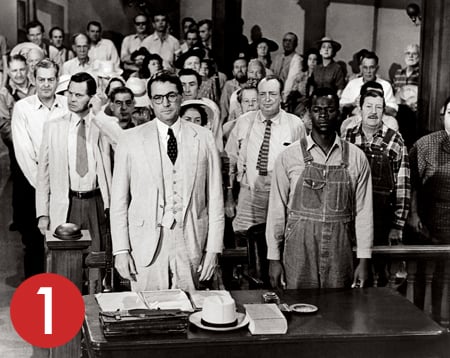
To Kill A Mockingbird (1962)
Gregory Peck lends his legendary dignity to the role of Atticus Finch, Harper Lee’s iconic small-town attorney. Penned for the screen by Horton Foote, the movie was an instant classic, as lawyer Finch rises above the naked racism of Depression-era Alabama to defend a crippled black man (Brock Peters) falsely accused of rape by a lonely, young white woman.
Finch’s quiet courage is seen through the eyes of Scout (Mary Badham), his 6-year-old daughter, and embraced by an emerging generation of lawyers as the epitome of both moral certainty and unyielding trust in the rule of law.
When the accuser’s drunken, incredulous father glares and asks Atticus, “What kind of man are you?” the unspoken answer is easy: both the self-assured lawyer and upright human being we all hope to be.
Trivia: Three Oscar wins. Finch was Lee’s mother’s maiden name.
Beyond courtroom drama: Find new movies on our 2018 all-time favorites list.
Related topics:
Features | Celebrities | Law in Popular Culture
You might also like:
- Teen shooters and their parents' responsibilities examined in Fox's 'Accused'
- 'What Jennifer Did': Senseless killings can take a toll on lawyers working the cases
- Kids create video, write law journal article about Texas Supreme Court
- Despite lyrics mistake by AI, lawyer wasn't ineffective for using tech in rapper's case, federal judge says
Most Read
- States can't ban guns in banks, hospitals and churches, but property owners can, 9th Circuit says
- Chief Justice Roberts steered rulings benefiting Trump, report says, citing internal information
- Law firm can sue over alleged fake online reviews that toppled its top rating, appeals court says
- California Supreme Court denies plan for new bar exam
- California law deans have 'grave concerns' about new bar exam plans
Topics: Career & Practice

Lawyer's solo honeymoon after her fiancé's death brings comfort and community
Your Voice

Lawyers must lead in efforts to preserve accessible, equitable and transparent rule-of-law system
Podcasts