
• Home
  • News
  • Top 10 Quotes From the Sotomayor Hearings

Supreme Court Nominations

Top 10 Quotes From the Sotomayor Hearings

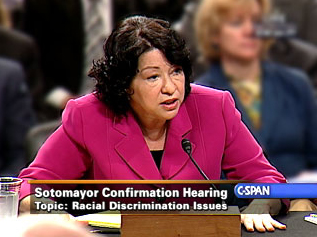
Posted Jul 16, 2009 3:31 PM CST
By Edward A. Adams

Editor's note: Click here for more Sotomayor hearings coverage.

In three-and-a-half days before the Senate Judiciary Committee, 2nd U.S. Circuit Court of Appeals Judge Sonia Sotomayor was an often-elusive witness, as has been the case with several recent U.S. Supreme Court nominees. Senators sought to understand her views on issues that are likely to come before the court; for that very reason, she often said she could not answer.

But there may be a few quotes that will live on in the public imagination and future news stories, should the full Senate vote to confirm her. Below are 10 of the most interesting soundbites from her testimony, listed in no particular order:


“The progression of my life has been uniquely American.”


“Fidelity to the law” — Sotomayor’s description of her judicial philosophy.


"In law school, you learn theory. In the prosecutor's office, law isn't legal theory, it's facts."


"No words I have ever written or spoken have gotten [as] much attention" as her comments in several venues about a “wise Latina” judge, including this 2001 construction: “I would hope that a wise Latina woman with the richness of her experiences would more often than not reach a better conclusion than a white male who hasn't lived that life.” In her testimony, she explained that "I was trying to inspire Latino students to believe that their lives could be inspired. That they could become anything that they wanted to become."


"Life experiences have to influence you. We are not robots," as judges.


"My reputation is that I ask the hard questions [of lawyers at oral argument], and I do it for both sides.”


Asked about the approximately $200,000 that associate justices earn, Sotomayor said she can "suffer through" a career with that compensation. "I've been living on this pay for years."


Sen. Al Franken, (D-Minn.), referring to a TV show Sotomayor loved as a child, asked "What was the one case in Perry Mason" that he lost?

"Gee," she said. "I don't remember."

"And you don't remember that case?" he asked. "Didn't the White House prepare you for that?"


Sen. Tom Coburn (R-Okla.), asked about citation to foreign laws in U.S. decisions. "Is it important that we look good to people outside this country?" he asked.

"We don't render decisions to please the home crowd—or any crowd," Sotomayor responded.


Sen. Jon Kyl (R-Ariz.) cited a statement by President Obama that "the law will take you 25 miles of the 26-mile marathon, but the rest of the decision is what's in a judge's heart. Do you agree?" he asked Sotomayor.

"No, sir," said Sotomayor. "The law decides what a judge does."

"Has there ever been a case where you've been guided by your gut?"

"Well," said Sotomayor, "lawyers have said to me that I've been."

Kyl followed: "Has there always been a legal basis for your opinions?"

"Exactly, sir," said Sotomayor.

Comments

1.

irwin eisenstein
Jul 17, 2009 5:21 AM CST

I was before Judge Sotomayor in a FCA action related to the failure to include factor in child support guidelines that would reduce bonuses.  She did not ask a question but the vote was still 3-0. 
  I could explain the issue to 10 year olds, but not to appellate judges!  It is fairly simple.  In child support the guidelines fail to take into account a new person who lives with or marries the custodial parent.  The result is that there are no economies of scale that are included. 
    when a custodial parent remarries, there is another adult who lives in the household.  Fixed costs account for about 65 percent of child support based on most income shares models.  (there were three.  Espanshade, Williams, etc.) 
    there is no reduction in child support in these situateions. 
  I use the example of two smart ten year olds.  they want to rent a motor boat.  It costs 40 dollars.  It is a large boat, so they decide to ask a friend.  Each friend contributes 10 dollars so the cost to each party is 10 dollars and not the 20 dollars if only two pay for the boat.  This is economy of scale. 
    When a custodial mother of 1 remarries, the fixed costs remain almost constant.  Especially if they remain in the former marital home. 
(heating, electrical, utilities, etc.  should be split but are not.)  the result is that the non-custodial parent pays for services that benefit the new lover or spouse. 
    Since state collect bonuses from the federal government for the amount of child support collected, if the support were adjusted down, they would receive less in bonuses. 
  Each state that touches the money gets a bonus of 6 percent of the collected child support.  If the child support is higher, the bonuses are higher. 
    The Stevens case US ex rel Stevens does not account for this situation even though a city or state is a party.  the law 42 USC 602 et seq.  says that the highest executive officer of a state is responsible for insuring that there is no fraud, nepotism etc. 
  Each year, States collect millions of dollars in excess child support, and also in federal bonuses to support a corrupt bureaucracy! 

 
    I did explain this to 10 year olds, but appellate judges do not appear to understand this issue.

2.

Michael Koeller
Jul 17, 2009 5:52 AM CST

The California Judicial system (Superior courts) and Attorney ethics are in a very bad state.  Decisions are made by administrative people, fFles are selectively screened & denied the Plaintiff in Web Domain publications,and physical files, and Judges release attorneys when they no longer feel the client has funds, and the released attorney continues to participate with the Judge and Defendants, after release, not to the best interest of the former client/plaintiff.  Is there any ethical, functional, financial solution to this delima?

3.

Michael Koeller
Jul 17, 2009 6:01 AM CST

On 4/10/09 the court, over plaintiffs objection released his attorney. The RPC 3-700(D) material was and is denied to the client.  The office minutes of the Attorney are important to obtaining a new attorney.  Are these documents included in the clients rights to recover?

4.

Bill
Jul 17, 2009 6:03 AM CST

“Confirmation hearings”?  Showmanship and fluff, largely.

When Tom Coburn was questioning her about the Second Amendment and the 14th Amendment, she misstated the fundamental rights doctrine.  She also had gotten it wrong the day before.  Amazing.  And then she totally ducked and dived and dodged his question about whether she beileved we have a basic right to self-defense. 

She also kept saying “eminent” when she meant “imminent” - as in “imminent death or serious injury”.  I’m still not sure what “eminent” death is. 

This lady seems to be about right to replace Souter, I guess.  At least she likely won’t move the Court any farther to the left.  One can only hope.

5.

Cellman49
Jul 17, 2009 6:21 AM CST

I don’t think anyone will ever refer to this Supreme Court nominee as a “constitional scholar.”  She is barely coherent in her responses!

6.

Hadley V.Baxendale
Jul 17, 2009 6:42 AM CST

Q: What is the difference between an Oklahoman & a total idiot?  A: The Red River.

7.

LanguageWeasel
Jul 17, 2009 7:28 AM CST

Gah!  Why can’t educated people use the language properly?  “Quote” is a verb and “quotation” is a noun.  These are “quotations” from the hearings, not “quotes.”

8.

Stephanie Lee
Jul 17, 2009 7:47 AM CST

I don’t know about you, but I pronounce “eminent” and “imminent” identically.  (“Pen” and “pin” too…)

9.

Lesley
Jul 17, 2009 8:08 AM CST

I pronounce “eminent” and “imminent” the same way as well—not sure if people realize this, but sometimes a person’s accent affects their pronounciation.

10.

B. McLeod
Jul 17, 2009 8:34 AM CST

For those who have not already picked up Hadley’s geographical reference (@6), to the east of the Texas panhandle, the Red River forms the Oklahoma-Texas border.

11.

Dlesq
Jul 17, 2009 8:50 AM CST

Actually, Webster’s online identifies “quote” as both a noun and a verb. Quote is a noun in some uses, much as “swim” can be a noun. For example, “I went out for a swim”.

12.

Bruce Eden, Civil Rights Director, Dads Against Di
Jul 17, 2009 9:32 AM CST

As conservative talk show host and constitutional scholar Mark Levin stated:  Sotomayor is an idiot.  She is unintelligent. 

Given the current state of the judiciary in this country, I would say Levin’s comments are an understatement.  We’ve got more cretins and idiots on the benches of the various states and federal courts than at any time in history.  They should be playing “Bring in the Clowns” every time Sotomayor and the Democrats walked into the hearing room.

13.

Lesley
Jul 17, 2009 9:34 AM CST

For all those people who keep saying she didn’t say enough, or wasn’t clear enough, read this: http://www.cnn.com/2009/POLITICS/07/17/borger.sotomayor/index.html

“WASHINGTON (CNN)—In the past decade, it’s become a given that Supreme Court nominees are expected to tell you—not to mention the senators actually voting on confirmation—absolutely nothing about how they will rule on the Supreme Court.

Think of it this way: a job interview without a hint of what the applicant would actually do on the job.

That’s because back in 1987, when Judge Robert Bork came before the Senate Judiciary Committee, he did answer questions. He also came with a long, scholarly record that outlined an obviously conservative judicial philosophy. He lost. And he lost ugly.

Looking back, Bork told CNN’s Campbell Brown this week, his honest approach was a big mistake.

“I think I could have been more intelligent in my approach and more aware of what was taking place,” he said. “I kept responding to questions as if it was a rational discussion, which it wasn’t. I think I would have taken that into account more if I were to do it over again.”

Exactly.”

14.

scj
Jul 17, 2009 9:39 AM CST

If she pronounced “eminent” and “imminent” identically, she would pronounce them both “IMinnent” in which case, nobody would know she’s mixing up the terms.  Instead, as I understand it, she is saying EMinent, when she mean IMinnent, and the misuse is clear.  Plus, she’s from NYC so she wouldn’t pronounce eminent and imminent the same way.

15.

sb
Jul 17, 2009 9:56 AM CST

Actually, LanguageWeasel, Merriam-Webster indicates that “quote” is correctly used as a synonym for “quotation.”

16.

AndytheLawyer
Jul 17, 2009 10:38 AM CST

Bruce Eden means to refer to Roberts, Alito, Thomas and Scalia, right?

17.

Mike
Jul 17, 2009 1:37 PM CST

Sen. Al Franken asks about Perry Mason episodes…..

Thanks a lot to the 1/2 of Minnesota who sent this guy to influence the country’s policies.

18.

Phil
Jul 17, 2009 3:10 PM CST

The reality is…the Congressman asking the questions are mopes and dopes who barely have a clue what they are talking about. Sotomayor is competent and probably qualified.  Obama won and, absent a scandal and evidence that she really is stupid (Harriet Miers??) she should get confirmed.  I don’t like it. I am more conservative and believe in a strict constuctionist approach. However, “advise and consent” is not the right to “appoint” or “nominate.”  And it does not give Senators the ritght to try to get potential justices to “promise” how they will rule on an area of law.  In the, the Supreme Court is an “equal” branch of goverment and the Senators cannot put conditions on their exercise of the judicial power.  Unfortunately, the “impeachment” check on run amok activitis justices does not exist and that is why—watch out who you vote for President.

19.

Harry Lawrence
Jul 17, 2009 5:12 PM CST

I assume that the overwhelming majority of readers—and hence commenters—are American lawyers.  Reading most of their poorly expressed and often inaccurately presented, badly thought out comments above, one is minded to wonder what sort of a level of intelligence is prevalent in the average US lawyer.  Maybe, therefore, it is not so surprising that such an intellectual lightweight as Sotomayor is being nominated and probably appointed to the Supreme Judicial tribunal.  Of course the politicians doing the vetting are clearly even more intellectually embarrassing than the nominated candidate—but then they are mainly lawyers too.  Anyone reading the US Constitution carefully can see that the Founding Fathers failed to pay much attention to the details of the all-important third arm and so gave everyone a very free rein in the composition, requirements for appointment and ongoing monitoring that ought to have been spelt out with some clarity.  That was a grievous error, unfortunately, in an otherwise admirable and thoroughly thought through document.  However I am certain that the Founding Fathers would have been horrified to discover what that has led to at this time.  Every judicial appointment nowadays is motivated and perused from a political rather than a legal standpoint.  In the end this leads to cynicism and lack of confidence in the ultimate Justice and Separation of Powers that the Constitution so desired to preserve and protect.  We should not be viewing nominations in terms of right and left-leaning but rather assess them in virtue of their judicial faithfulness to the current set of laws against a background of the present state of the Constitution.  Here, “present state” is not meaning ‘present interpretation’ but rather what each article and amendment meant at the time they were enacted.  Not of course what each legislator or Founder individually intended them to mean but what in all justice and honesty they actually did mean, according to the understanding of the words at that time.  If that were the case, it would not be thought unreasonable for this nominee to be closely quizzed on her adherence to these strict interpretive standards rather than the virtues or otherwise of the superior empathy of an Hispanic woman of humble beginnings.  Someone unwilling, or unable to express a clear position on that central issue—the willingness to strictly uphold both Constitution and extant legislation without a trace of Judicial Activism—ought not to be considered a fit candidate for a position of Associate Justice.

20.

James Pollock
Jul 17, 2009 8:26 PM CST

Mr. Lawrence at 19 above seems to have fallen into the trap of defining “activist judge” as “a judge who rules differently from what I wanted.”  Judicial appointments have ALWAYS been political.  Perhaps a re-reading of Marbury v. Madison is in order (What was Marbury suing about?).  Or are we to infer from this argument that John Marshall was unfamiliar with the Framers’ meaning in the text?  After all, he had to invent judicial review in the first place, because it isn’t in the Constitution (at least, not explicitly… it’s there because Marshall said it was, and nobody’s yet successfully claimed it isn’t).  “Judicial Activism” is what you get when the judiciary exercises its valid authority as a coequal branch of government, and corrects an overreaching Congress, i.e., when it acts as a check or a balance, as the separation of powers doctrine intends.  I am sure the Founding FATHERS would have been horrified by many things in our society today, like women voting, but the way judges are nominated and confirmed is not one of them.

21.

BMF
Jul 17, 2009 9:15 PM CST

“I use the example of two smart ten year olds.  they want to rent a motor boat.  It costs 40 dollars.  It is a large boat, so they decide to ask a friend.  Each friend contributes 10 dollars so the cost to each party is 10 dollars and not the 20 dollars if only two pay for the boat.  This is economy of scale.
  When a custodial mother of 1 remarries, the fixed costs remain almost constant.  Especially if they remain in the former marital home.
(heating, electrical, utilities, etc.  should be split but are not.)  the result is that the non-custodial parent pays for services that benefit the new lover or spouse.”

Your model assumes that the ex-wife’s BF/new spouse has a duty to contribute to ex-husband’s rowboat rental—er—kids’ maintenance and support.  They’re ex-H’s financial responsibility. The judges made the right call—based on precedent and public policy.

22.

B. McLeod
Jul 18, 2009 8:56 AM CST

The founders knew how crown judges were appointed.  Perhaps they did not see a need to speak to the issue, beyond splitting the appointive power to require legislative confirmation.  In their time and historical context, they had to have understood the resulting process would be political.

23.

Harry Lawrence
Jul 20, 2009 3:01 AM CST

Mr Pollock I am surprised at you.  I thought that you had actually read my comment, but you seem to have responded to it without benefit of understanding of what I wrote.  We learn nothing whatsoever concerning the Constitution’s view of the role of Justices on the bench from Marbury v. Madison—only that Judicial Review became imported into the Court’s role to fill in some of the vacuum left by the lack of explicit terms of reference for the Court in the Constitution.  It is true that Marbury was suing for a writ of mandamus because of Madison’s refusal to confirm him, but there is no evidence that this was a matter of left versus right, or activism versus originalists or textualists.  The Court ruled that the Judiciary Act of 1789 was unconstitutional.  It was asserting its role as guardian of the Constitution as was indeed intended by the Founding Fathers—see The Federalist Papers. 
What I was trying to say was really quite straightforward.  The reason for having a constitution in the first place is so as to create a basic stability to assure the nascent States and the population at large that certain things would remain inviolable despite temporary legislative majorities committed to this or that.  As any student of political history of the US—or any other democracy for that matter—knows , majorities come and majorities go and without check each tidal change could easily alter basic rules and laws so as to satisfy their radical followers and, in extremis, even emasculate the democratic system itself.  Even if the swinging pendulum of politics could redress the balance and once again reinstall the former status quo yet this very unsettled atmosphere would be most uncomfortable for all and would militate against the sound development and secure progress that would be the hallmark of good government.  A constitution lays down what are in fact certain basic laws that are not to be altered or impinged upon by any legislative acts, hence ensuring that these laws will remain in perpetuity.  However, because it is understood that in the fullness of time circumstances may alter or the desires of The People may change there is provision, by inclusion amongst these basic laws, of rules whereby additions or changes can be made to the constitution itself.  In the US Constitution this involves various super-majorities in both halves of the legislature as well as amongst the States, plus the assent of the Executive.  This is the only mode whereby changes should be made to the Constitution and its original meaning.
The guardians of the constitution are the Justices of the Supreme Court.  Their job is to see that the Constitution is strictly adhered to at all times—that there be no change whatsoever to the original meaning that exists as expressed intention in the very words of the Constitution.  Not that there be social justice or desirable laws, not even to ensure that the will of the People be made manifest.  Those matters are the tasks of the political Legislature and Executive.  Those changes can be driven by the will of the People as expressed in frequent elections as laid down in the Constitution.  If it becomes desirable that slaves should become free men and have equal citizenship and voting rights then we proceed to legitimately generate the 13th, 14th and 15th amendments to the Constitution, thus creating new ground rules.  If it becomes desirable for women to have equal voting rights then we can create the 19th Amendment.  However what is not legitimate is the judicial activism of the Borg and Warren courts that sought to change the social adjustments of American society ‘for the better’—and succeeded.  Unfortunately they were in fact usurpers of our constitution—not its guardians.  Quis custodiet ipsos custodes?

24.

Harry Lawrence
Jul 20, 2009 3:16 AM CST

I am sorry. I meant Warren E. Burger court—NOT Borg.

25.

Evil Revolutionary
Jul 20, 2009 3:22 PM CST

Mr. Lawrence understands the difference between a democracy and a republic. Remember that the racist laws of Nazi Germany were passed by legitimate majority votes under their governing documents.

We NEED limits on government, even at the expense of some inefficiency and ineffectiveness.

Sotomayor may not understand the fundamental elements of statutory construction in light of 14th Amendment restrictions on Congressional power.

I also believe that she is a huge potential danger to individual liberty, as she seems to swallow the facile doctrines of “selective incorporation” of the 14th Amendment beyond its truly valid application to the grand jury indictment and jury trial in civil cases elements of the Bill of Rights. The rest of the arguments against incorporation use high-sounding rhetoric to eviscerate “privileges and immunities of citizenship”.

Sotomayor’s refusal to interpret “plain language” of a statute to avoid “absurd results”, as previously decided by administrative action that was “due deference” by the federal appeals court, resulted in a results-oriented decision, improper application of the law, and ultimately reversal by SCOTUS. The recent decision clarifying that there must be facts based on evidence to justify a “disparate impact” decision would not have been necessary to correct a judge who truly follows the law and precedent.

26.

Jim | 2009-07-20-Mo 1703 -0400
Jul 20, 2009 3:37 PM CST

#24 by Harry Lawrence
c. 0557 -0400 Mon. 20 July 2009
(curious & finding out ....)

I am sorry. I meant Warren E. Burger court—NOT Borg.

Mr. Lawrence, sir, you were forgiven at line 1 of #23 !

:-) You mean there was a difference?! :-)

PS: Today is the 65th anniversary of Oberst Claus Schenk Graf von Stauffenberg’s failed attempt at tyrannicide.

Gedenktag des Attentats auf Hitler 1944**   

Commemorative day of the assassination attempt on Hitler in 1944   20. Juli - Germany

**This is more of an observance than an official holiday. On July 20, 1944 an assassination plot against Hitler failed when a bomb placed by Claus Schenk Graf von Stauffenberg detonated but only injured the dictator slightly. Von Stauffenberg and his fellow conspirators were arrested and hanged. Today von Stauffenberg and the other plotters are recognized for trying to end Nazi terror and restore democracy in Germany.

27.

John
Jul 21, 2009 12:21 PM CST

Mr. Lawrence @23 writes: “What I was trying to say was really quite straightforward.” Maybe it would help to be a little more succinct - even the sentence I quoted could be reduced by at least three words.  Perhaps you were trying too hard to prove how much smarter you are than the typical American lawyer. 

Although verbose, your argument is still too simplistic when applied to real-world cases.  Relying on a document over 200 years old to resolve every modern legal issue is like relying on the Bible to build a computer.

28.

Harry Lawrence
Jul 21, 2009 3:07 PM CST

In reply to John #27.
Whereas succinct is a virtue, complete is a greater virtue.  However, verboseness has nothing whatever to do with smartness.  You are succinct –but then you fail to make any kind of a case.  To say my argument is “too simplistic when applied to real-world cases” and “relying on a document 200 years old to resolve every modern legal issue is like relying on the Bible to build a computer” is not only fallacious but hyper–simplistic, what is more it fails in its terseness to make any a reasoned case—not surprisingly since it is totally wrong.  I tried, after my first apparently unsuccessful attempt, to explain exactly what the case that I was making was in sufficient detail to satisfy even a less than insightful American lawyer—but it seems that I have failed yet again.  Maybe that is totally my fault, and if so then I apologise.  The Constitution is NOT 200 years old.  At this point it is just 17 years old—Amendment XXVII is dated 1992.  A constitution is meant to be an everlasting law—like the Bible—though unlike the Bible it is subject to amendment all the time and thus it is what Justice Breyer calls “a living constitution.”.  Neither the Bible nor the Constitution was ever intended as a manual on how to build a computer so anyone thinking otherwise would be like an electrician trying to use the Gas Code when wiring a building.  The Bible is intended to explain how a person should best run their lives and the Constitution lays down how to run the United States of America.  Anything that becomes outdated is fixable by amendment—as envisaged in the Constitution itself.  The Supreme Court’s function is to uphold that constitution and the lawfully enacted legislation of Congress, and where necessary to assert the primacy of the former over the latter.  To legislate from the bench is an obnoxious usurpation of power which unfortunately has no redress-  quis custodiet ipsos custodes?  Therefore those that are nominated to be appointed to bear this awesome burden of power need to be examined in great detail to determine if they harbour such invidious tendencies.  That is why Sotomayor’s case is so troubling, because she has expressed herself as being one who believes that her personal experiences and background are significant factors in making judgements.

29.

R
Jul 22, 2009 9:49 AM CST

Any commenter who refers to Sotomayor as “unintelligent” or an “idiot” is just plain silly.

I was expecting more quotes from those gasbag senators like that insufferable Republican who actually said that Sotomayor had “some ‘splainin’ to do.” Or the other Republican who seemed puzzled that Sotomayor wouldn’t have taken the same side on a case as another judge who happened to be of Puerto Rican ancestry.

30.

R
Jul 22, 2009 9:51 AM CST

Hey Harry Lawrence: for heaven’s sake, put some spaces between your paragraphs. And write reasonably-sized paragraphs.

Your ridiculously long paragraphs are almost impossible to read. Do you write briefs that way? If you do… good luck!

31.

James Pollock
Jul 22, 2009 10:00 AM CST

The Constitution defines the powers of the three branches of the federal government.  The wonderful thing about it, the reason it has been able to endure for so long, is that these boundaries are NOT static.  There are times where, as recently, the executive claims more power at the expense of Congress’.  There are other times where the Congress makes inroads on executive power.  There are times when the courts check either the Congress or the executive.  And there are times where the Congress or the executive limit the power of the Courts… and amending the Constitution is NOT the only way to do this.  There is no way onto the Court except through the executive and the Senate.  Control over nominations to the Court is one of the spoils of election.  The Constitution is a wonderful document, a blueprint for a functional government.  But it is intentionally short, and it intentionally omits details.  The Framers intended that those who would come later would spell out those details as they saw fit to do so, and those details could and would change if necessary.

32.

sally
Jul 22, 2009 11:03 AM CST

No one cares about the Constituion anymore.  We have Barry the Kenyan in the white house.  We are now under international law.

Add a Comment

We welcome your comments, but please adhere to our comment policy.

Commenting has expired on this post.