

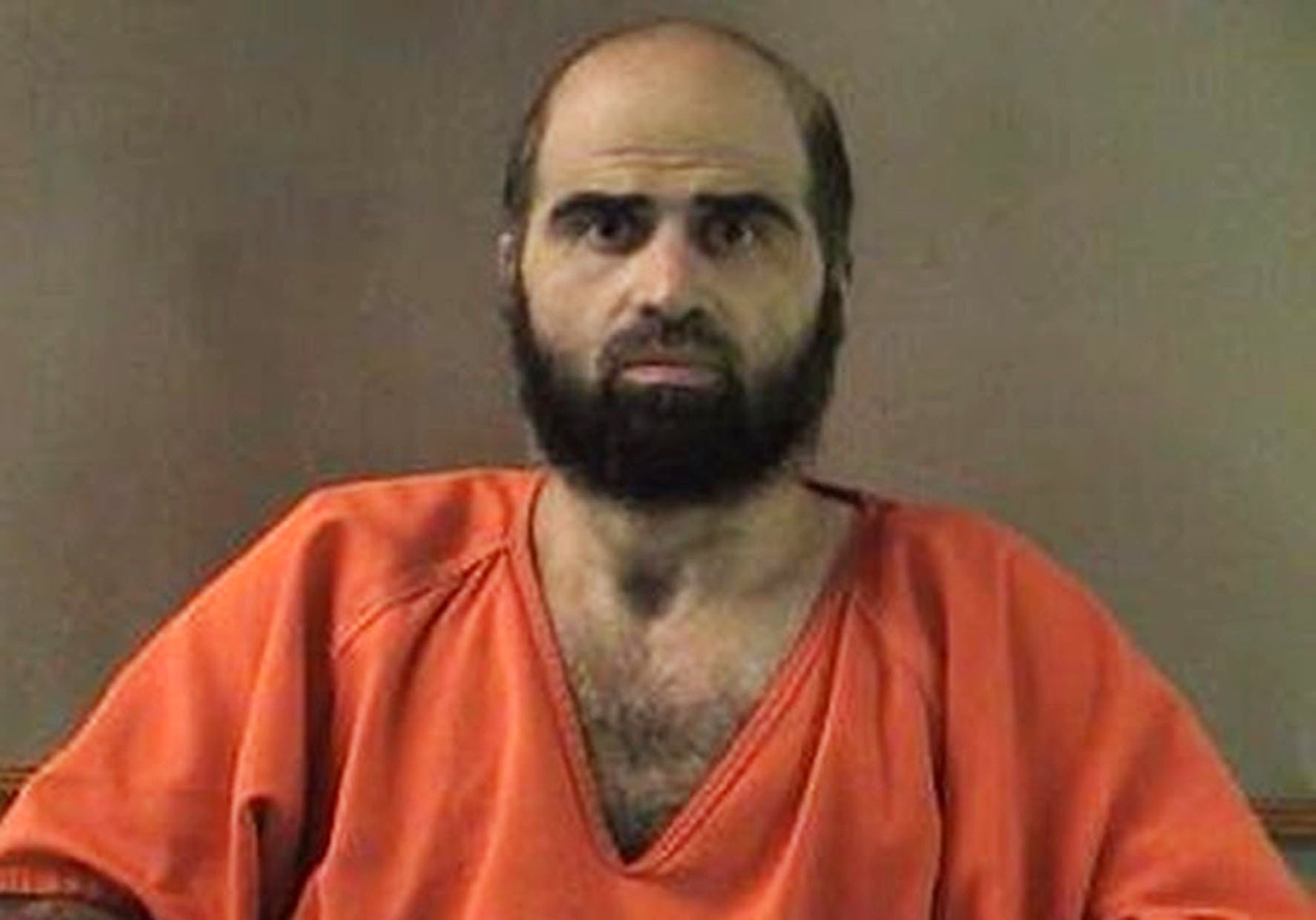
Updated: President Donald Trump said Thursday morning the Pentagon would not be livestreaming the execution of Fort Hood shooter Nidal Hasan. Before the Thursday announcement, military lawyers interviewed by the ABA Journal voiced their concerns.
The play by Trump's administration to livestream the military execution of Nidal Hasan, the 2009 Fort Hood mass shooter, is a poor decision that potentially endangers the U.S., but it’s likely to be found legal by courts, lawyers say.
Retired Maj. Gen. Steven J. Lepper, a former Air Force deputy judge advocate general, says that the decision is likely “lawful but awful.”
Lepper, who served as interim director of the ABA Rule of Law Initiative, is one of the founders of the Former JAGs Working Group, which issues statements and briefs on military topics.

He adds that there’s “overwhelming” belief among former and retired military lawyers that the plan is “beneath our American values, contrary to international human rights law,” as well as an assault on military professionalism and a danger to U.S. national security.
Defense Secretary Pete Hegseth has said that the public will be able to livestream the Dec. 3 execution of Hasan, a former U.S. Army psychiatrist. He has been sentenced to death for murdering 13 people and wounding 32 others at Fort Hood in Texas.
Archbishop Timothy Broglio, who oversees the Catholic Church’s pastoral services to Catholics in the U.S. military, said that a Catholic soldier assigned to the firing squad should ask to be excused from that duty, which he said was contrary to the teachings of the church.
Amid bipartisan pushback, President Donald Trump said Wednesday they were looking into livestreaming the execution. The White House did not immediately respond to a request for comment, and the Pentagon directed comment to Hegseth’s social media post confirming livestreaming.
The last high-profile public execution in the U.S. was in Kentucky in 1936, when Rainey Bethea was hanged in a parking lot, according to the Washington Post. An estimated 20,000 spectators gathered in what has been described as a carnival-like atmosphere to watch Bethea, a Black man, be killed after his conviction for the rape of a 70-year-old white woman.
Margaret M. Donovan, a former military lawyer who now works in the Bridgeport, Connecticut, office of Koskoff Koskoff & Bieder, says that the law “surrounding military executions does not speak directly” to the issue of livestreaming executions, although she says that it’s “entirely possible that there may exist a challenge out there, somewhere.”
Donovan notes that a specific U.S. Army regulation—AR 190-55—governs military executions and is silent on whether they can be public or not.

However, the regulation does specifically prohibit people under the age of 18 from being witnesses to executions. Donovan points out that Hegseth and Trump can generally override regulations.
Lepper says that if the execution is livestreamed, then “people of all ages” will be able to watch it.
“The question I and other attorneys should ask is whether this prohibition is so fundamental to our values as a nation that it cannot be waived by the secretaries of the defense or the Army,” Lepper says.
There’s always a possibility of a last-minute stay, but also a question as to who has standing to file a lawsuit.
Brenner Fissell, a professor at Villanova University Charles Widger School of Law and vice president of the National Institute of Military Justice, says that the most likely plaintiffs would be parents of children who could end up watching the livestreamed execution.
However, Fissell adds, a judge could ask why parents didn’t simply stop their children from watching.
Eugene R. Fidell served in the U.S. Coast Guard and co-founded the National Institute of Military Justice, a nonprofit organization. He says that livestreaming the execution “needlessly puts us on the wrong side of settled human rights jurisprudence” under the International Covenant on Civil and Political Rights.
A visiting lecturer at Yale Law School, Fidell also emphasizes that the execution could add “fuel to the growing movement to abolish capital punishment,” particularly after last month's botched execution of Christa Pike, a Tennessee woman sentenced to death for a murder committed in 1995.
Hasan, who had been scheduled to deploy to Afghanistan, targeted soldiers at Fort Hood’s Soldier Readiness Processing Center as they were getting medical checkups. He fired more than 200 shots before he was stopped. An Army police officer shot him in the chest. Hasan is now paralyzed from the chest down.
Hegseth says he recommended that Hasan be executed by firing squad. Although that method of execution hasn’t been used since 1945, it remains valid under military law.
Lepper points out that Hasan could file a habeas petition to stop the execution but says he doesn’t think Hasan will.
“Hasan is at the precipice of martyrdom,” Lepper says. “Many believe that’s exactly what he wants. He knows he will die for his crimes. Why should he object to the public watching as a firing squad riddles his … body with bullets?”
What better way, Lepper says, to become a martyr and “inflame the passions of the enemy the United States is currently fighting in the Middle East?”
But Franklin Rosenblatt, a professor at Mississippi Christian University School of Law and president of the National Institute of Military Justice, predicts that Hasan will seek a stay in his execution.
“If he pursues habeas, the process may outlast the current president who ordered him to be executed,” Rosenblatt says.
Updated Oct. 15 at 10:12 a.m. to include additional reporting on the halting of the livestreamed execution of Nidal Hasan.








