
In 2020, Blane Prescott served on the compensation committee of an Am Law 100 firm that boosted one equity partner’s pay to an unheard of $20 million.
While groundbreaking at the time, some BigLaw partners now command dramatically higher pay packages, says Prescott, the managing shareholder at MesaFive, a management and strategy consulting firm in San Francisco that works with law firms on matters including partner compensation and profit improvement.
“We’ve gone over $40 million to the highest-paid partner, which is crazy-level numbers,” says Prescott, who served as Foley & Lardner’s chief operating officer from 2014-2018 and as Brownstein Hyatt Farber Schreck’s CEO from 2010-2014.
These aren’t isolated incidents. According to recent reports from legal industry observers, more BigLaw partners than ever are raking in serious money, with the top earners hitting $40 million or more in total compensation, including bonuses that are 30% to 40% of their base pay. Higher still, Kirkland & Ellis, the top firm in the 2026 Am Law 100 for gross revenue, in April reportedly gave Joshua Feltman a pay package of $80 million over three years to join the firm from Wachtell, Lipton, Rosen & Katz.
“At the top end of the market, among the largest and most profitable law firms, some of the compensation that’s reportedly being paid is unlike anything legal has ever seen,” says Kent Zimmermann, co-chair of the Zeughauser Group, a legal management consulting and advisory firm in Newport Beach, California. “It sounds more like professional baseball.”
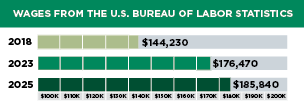
Massive pay increases aren’t unique to the top firms in the profession. The ABA Profile of the Legal Profession compiles statistics about lawyers, including data on wages from the U.S. Bureau of Labor Statistics. In 2018, the average lawyer salary was $144,230. By 2023, the average lawyer salary jumped to $176,470. In the most recent data from the Bureau of Labor Statistics, which doesn’t include profits for law firm partners and shareholders, lawyers nationwide made an average of $185,840 in 2025.
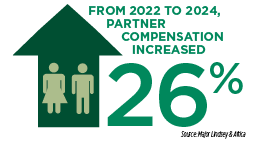
While not every partner makes more than $40 million a year, studies show their payouts are trending upward across the board. Major, Lindsey & Africa’s 2024 Partner Compensation Survey found that average partner compensation increased by 26% between 2022 and 2024 to $1.4 million. This is a record increase in compensation, according to the legal recruiting firm and consultancy, which surveyed more than 1,700 Am Law 200 partners.
Average compensation for partners nearly doubled between 2014 and 2024, Major, Lindsey & Africa also noted.
“BigLaw has just gotten bigger,” says Karen Andersen, a partner in Major, Lindsey & Africa’s partner practice group in Los Angeles. “It’s the best way to say it.”
Diving deeper, the relatively healthy economy is one driving force behind the uptick in lawyer pay.
The nation’s gross domestic product—its output of goods and services—has largely continued to grow quarter-over-quarter in the years since COVID-19, according to the U.S. Bureau of Economic Analysis. Business investment and consumer spending helped propel this growth, despite concerns about high prices and interest rates.
The labor market, another contributor to overall economic health, has fluctuated more in recent years. But the Bureau of Labor Statistics shows that in the first half of 2026, hiring by American employers in the professional and business services industry, which includes the legal sector, continued to trend upward—albeit with a slowdown in June during which the expected number of jobs added fell far short of economists’ predictions. Despite that, the overall unemployment rate actually fell slightly between May and July, going from 4.3% to 4.1%.
The legal profession is a “follow-the-money profession,” and when businesses are successful, it tends to bode well for law firms, Zimmermann says.
“The performance of the macroeconomy has everything to do with why a very large group of lawyers are making more and more money over time,” he adds. “The U.S. economy is nothing if not resilient, and so too are law firms.”
The legal market, especially coming out of the pandemic, has remained robust with significant corporate transactions and litigation, Andersen says. As clients’ deals grow larger and more complicated, they need elite partners who can handle the work. Partners benefit from this persistent high demand, including by being able to raise their billing rates. Increases in originations and billing rates were the main factors in the recent record increase in partner compensation, Andersen adds.
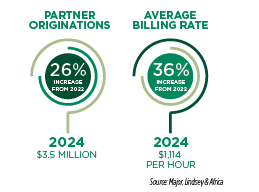
Average partner originations climbed to nearly $3.5 million in 2024, which marked a 26% increase from two years prior, according to Major, Lindsey & Africa’s Partner Compensation Survey. Meanwhile, the average billing rate for all partners who responded to the survey was $1,114 per hour in 2024, which was a 36% increase from 2022.
“What has continued to drive this is a lot of demand on the high level, which is what filters into BigLaw all the way down into the Am Law 200,” Andersen says.
In the current economy, as clients also grow larger, their work tends to be consolidating around fewer top law firms, Prescott says.
“You could have a matter that’s $100 million, and if it’s really due to one person, that creates a lot of compensation,” he says.
There’s a strong correlation between relative revenue and profits and relative flexibility on compensation. “As firms get bigger and more profitable, they have more money to invest in the people, and that has led many firms to increase the level of compensation they pay to their lawyers,” Zimmermann says.
While not an entirely new concept, many firms are growing their revenue at a faster pace than in past years, in part because of increases in billing rates as well as billable hours, Zimmermann adds. This allows these firms to pull ahead in many respects, including in their ability to compete with similarly situated or even larger firms on lawyer pay.
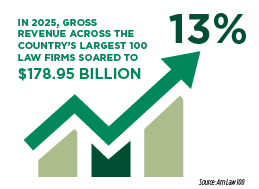
The 2026 Am Law 100 supports this, showing gross revenue across the country’s largest law firms soared to $178.95 billion last year, a 13% increase over the previous year.
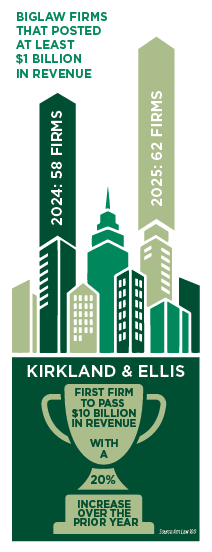
Kirkland & Ellis, which brought in $10.56 billion, became the first firm in the world to pass the $10 billion revenue mark. That was a nearly 20% increase over the prior year for the firm.
In another measure of accelerating BigLaw growth, 62 firms posted at least $1 billion in revenue in 2025, which was up from 58 firms in 2024.
The 2026 Am Law 100 likewise shows huge spikes in partner payouts. Profits per equity partner at firms was up 14% in 2025. Wachtell Lipton became the first firm ever to top $12 million; its $12.15 million in profits per equity partner was a 34% increase from 2024. Among the nation’s top 100 firms, 70 had a growth rate of at least 10% in profits per equity partner in 2025, while only two showed declines.
The 2026 Am Law 100 also indicates average compensation for all partners—which is based on the total payout to equity and nonequity partners—increased by 11.6% last year. More than half of firms experienced double-digit gains in their entire partnership’s compensation.
This concept doesn’t just apply to firms in the Am Law 100, Zimmermann notes. He has seen even smaller firms “put the pedal down” on growing their size and profitability to help improve their position on compensation.
“This keeping up on size and profitability to be able to be in the same league on compensation—that is a huge focus of people who run law firms today,” Zimmermann says. “And if it’s not, it should be because they have an imperative to at least be in the same league as their competitors on compensation.”
Firms that focus on building their ranks of more senior, experienced lawyers also are driving up compensation.
That’s a trend being closely tracked by Gretta Rusanow, the managing director and head of law firm advisory services for Citi Global Wealth at Work’s Law Firm Group. She notes that in 2025, law firms saw a nearly 3% growth in head count, which mostly came from salaried lawyers; specifically, firms saw a 6% increase in their number of income partners.
“There is a dual combination of strong growth in head count occurring last year, and that shift to a more expensive leverage model, which is a trend we’ve been seeing for the last few years,” says Rusanow, whose team collects quarterly and annual data on the performance of firms in the Am Law 200 and some smaller firms.
“I would say those are the two primary drivers of why you see the compensation expense number go up—which, in the case of last year, was 9.8% on average for our sample of Am Law 200 firms and firms outside of the Am Law 200,” she adds.
This was also reflected in Major, Lindsey & Africa’s Partner Compensation Survey, which shows that even though equity partners continue to earn significantly more than nonequity partners, nonequity partners have made notable gains in compensation.
In 2024, equity partners at Am Law 200 firms reported average compensation of $1.94 million, which was more than three times higher than the average compensation of $558,000 reported by nonequity partners, according to the survey.
While equity partners’ average compensation rose by 32% since 2022, when it was $1.47 million, nonequity partners’ average compensation also rose by 21% in the same period. In 2022, it was $460,000.
This was the highest recorded compensation for nonequity partners, and only the second time nonequity partners reported double-digit percentage point increases in their compensation in the survey’s history, Andersen says.
“When we did this survey, we thought that suggested that market forces, particularly law firms’ need to attract and retain talent at the nonequity level, significantly impacted compensation strategies,” Andersen adds.
More firms have moved to a two-tier partnership system to retain their top talent and give their lawyers a better opportunity to build a book of business that will be worthy of equity, Rusanow adds.
Sidley Austin and Arnold & Porter Kaye Scholer are among firms that recently created an income partner tier. At Arnold & Porter, attorneys who are internally promoted will generally start as income partners before they are eligible to become equity partners. According to global co-chair Michael Daneker, who spoke to Law.com in March, the firm made the change to give attorneys time to grow into their roles and to help the firm compete in the lateral market.
Income partners don’t share in the profits of the firm, but Arnold & Porter reportedly said they will receive a significant amount of professional development training and opportunities to prepare them for equity positions.
Rusanow anticipates firms’ continued investment in income partners may come with its share of challenges. Among them, it could result in “a ballooning” of income partners who expect to eventually become equity partners, she says. As law firms make hard decisions about who to promote and who to let go, it could shake up the profession.
“After three or four years, you’ll have a sizable proportion who are not going to make the equity cut,” Rusanow says. “There will be a potential flood of people in the market trying to look for a new home.”

The rise in lawyer compensation trickled down to associates, who now are receiving their highest salaries ever at several BigLaw firms.
In June, Milbank reportedly raised its starting salary for associates for the first time in three years to $235,000. Its most senior associates now make as much as $455,000. Other firms—including McDermott Will & Schulte, Quinn Emanuel Urquhart & Sullivan, Katten Muchin Rosenman and Seward & Kissel—quickly matched Milbank’s new associate salary scale. Another firm, Susman Godfrey, went even higher, moving its starting salary for associates up to $240,000. “I think some firms are raising associate salaries because they can and believe it will advantage them in recruiting and enhance their brand in the market for talent,” Zimmermann says.
He notes that the firms raising associates’ salaries are not among the largest BigLaw firms, which have more associates and would face a larger expense in shifting their pay scales.
“But if history is any guide, many larger firms will follow and match,” Zimmermann adds.
Some legal industry observers caution that these salary raises are at direct odds with law firms’ increasing reliance on artificial intelligence, which threatens to change their structure and operations.
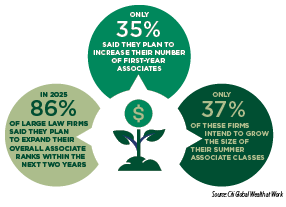
While 86% of large law firms said in 2025 that they plan to expand their overall associate ranks through the next two years, only 35% said they plan to increase their number of first-year associates, according to Rusanow’s data at Citi. Only 37% of these firms intend to grow the size of their summer associate classes, this data also shows.
“There’s a broad view that as AI comes more into the way a law firm operates, it is even more likely that we’ll see a greater dependence on more senior, more expensive lawyers,” Rusanow says.
There’s no question that some tasks that historically were completed by junior lawyers will be completed instead
by AI, but they’ll likely be supervised by junior lawyers, Zimmermann says. He expects that larger firms with more resources may have the advantage in adapting to AI and training junior lawyers on how to use it effectively and with accuracy.

“It’s early innings,” Zimmermann says. “AI is relevant already, but just how much it impacts firms—I think that story hasn’t been written yet.”
Another uncertainty is whether lawyer compensation will continue to be influenced by such factors as gender
and geography. The average compensation for
male partners was 29% higher than for female partners in 2024, according to Major, Lindsey & Africa’s Partner Compensation Survey. It found that male partners made an average of $1.7 million compared with female partners, who made $1.2 million on average.
But for the first time, Major, Lindsey & Africa identified that male and female partners’ compensation grew at the same rate, both up by 37% since 2022. “That gap between men and women has just dramatically narrowed from prior surveys over time,” Andersen says.
The ABA Profile of the Legal Profession also has illustrated that the average wage for lawyers is highly dependent on where they practice. In 2023, San Jose, California, reported the highest average lawyer salary at $268,570, which was four times greater than what lawyers were generally paid in Mayaguez, Puerto Rico, which reported the lowest average lawyer salary at $62,380.
Will compensation continue its steep ascent across the entire legal profession? That’s another outstanding question.
From his vantage point, Prescott expects lawyer salaries to keep rising.
“While the assumption might be that salaries rise only with increasing profits, they also rise in relatively flat economic times because some partners continue to increase their book of business and productivity relative to the rest of the firm,” he says. “As a result, they receive more compensation.”
A sudden economic downturn could reduce overall firm profits and subsequently suppress lawyer salaries, Prescott says. But, he adds, this also depends on the type of downturn.
“Some downturns have ironically been good for law firms,” Prescott says.