“Do you expect me to talk?”
“No, Mr. Bond, I expect you to die.”
– Goldfinger (1964)
***
Historically, torture scenes in pop culture signaled villainy. James Bond villains devised elaborate death traps, Big Brother tried to break Winston Smith in 1984, and the bad guys in Star Wars and Star Trek tormented heroes like Han Solo and Captain Picard. Torture was a bright line only evildoers crossed.
Even when torture scenes were parodied in Monty Python skits or in movies such as Dude, Where’s My Car? or Shrek, it was typically the antagonists doing it.
Then 9/11 happened.
For a country reeling from the attacks and seeking reassurance and retribution, a new pop culture hero emerged who stood for the proposition that stopping terrorism justified almost any means, however brutal, illegal or immoral.
Jack Bauer, protagonist of Fox’s 24, spent 8-1/2 seasons and a TV movie racing against the clock to stop attacks on the United States. Premiering less than two months after 9/11, the show starred Kiefer Sutherland as a driven counterterrorism agent who prevented chemical attacks, assassinations, cybercrimes and several nuclear explosions against the backdrop of a ticking clock to underscore the imminent danger he and his country were in.
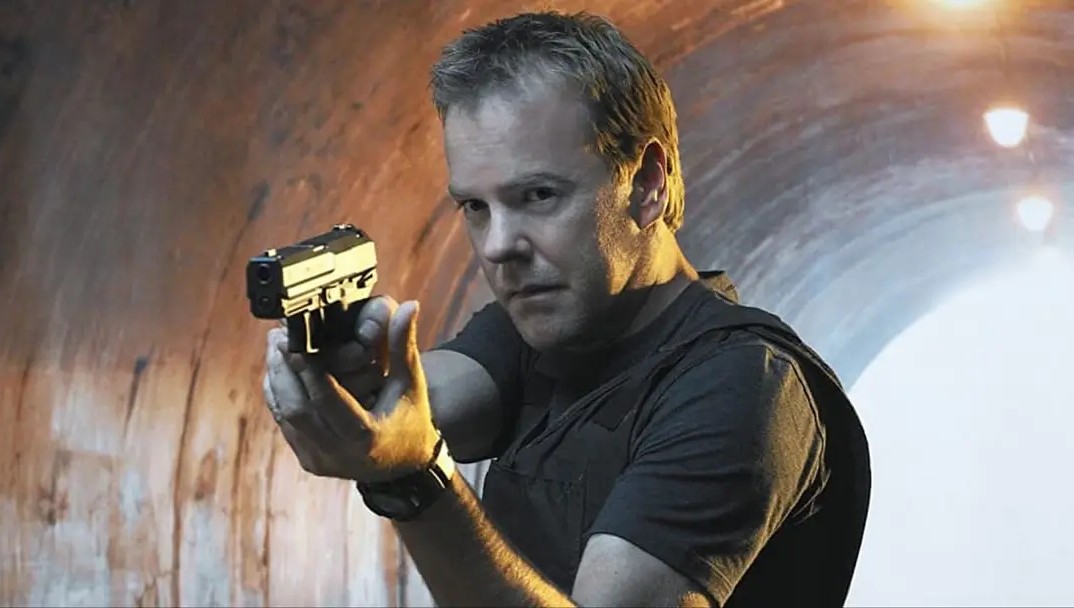
Through it all, Bauer’s most reliable weapon was torture. He used everything from truth serums to biometric readers to low-tech solutions like plastic bags, lamps, towels and his own two hands (and feet, legs, and in some cases, his teeth). Sometimes he would just cut the Gordian knot and shoot someone, making sure to aim somewhere that wouldn’t immediately kill them. The message was consistent: torture worked, and it saved innocent lives.
Bauer was hardly alone. Zero Dark Thirty (2012) reinforced the idea that torture helped find Osama bin Laden, while shows like Lost, The Shield and Game of Thrones often depicted torture as useful outside counterterrorism.
That attitude resonated after 9/11. “There was this real lack of intelligence that the U.S. had about al-Qaida, forcing us to operate from a position of ignorance,” says Elisa Massimino, visiting professor of law and executive director of Georgetown Law's Human Rights Institute. Shows like 24, she says, implied that tougher tactics might have prevented terrorist attacks.
There was also “a real desire for revenge,” Massimino says. In 2006, Massimino and military officials met with 24 producers, who she said called the show a post-9/11 revenge fantasy. Massimino warned that it functioned as "a one-hour advertisement for torture that 15 million Americans watched every week."
She adds, “It was also being watched in the Middle East, where it had a very different impact. It functioned as a kind of reverse propaganda and was basically designed to inspire that audience to want to take up arms against the United States.”
Bauer became a hero to viewers and people in power. According to Newsweek, in 2002, military officials at Guantánamo Bay were taking interrogation ideas from the show. Secretary of Homeland Security Michael Chertoff praised the show for reflecting “real life,” and U.S. Supreme Court Justice Antonin Scalia defended Bauer in a lecture while stating that extraordinary circumstances sometimes call for extraordinary solutions.
John Yoo helped enshrine that logic. As a U.S. Department of Justice lawyer from 2001 to 2003, Yoo co-authored memos—later nicknamed the “torture memos”—giving legal cover to enhanced interrogation tactics. While Yoo later claimed he never watched 24 during his time in government, he would cite Bauer and the ticking-time-bomb scenario to justify harsh interrogation tactics in his 2006 book, War by Other Means.
Policymakers at the time had a virtual blank slate since the American public had not thought much about torture in the years leading up to 9/11. The Roper Center at Cornell University notes that little polling on torture existed before 9/11, and the limited data showed an American public largely indifferent or uninformed.
That soon changed. In October 2001, a Gallup/CNN/USA Today poll found that 45% supported torturing known terrorists to prevent attacks, while 53% said torture was rarely or never justified. The issue continued to be divisive. The Pew Research Center found in 2007 that 43% of Americans said torture could be justified while in 2009, an NBC News/Wall Street Journal poll found that 46% believed harsh interrogation tactics had provided valuable information. In 2014, an NBC News/Wall Street Journal poll found that 51% believed the CIA's enhanced interrogation practices had been "acceptable under the circumstances."
David Luban, a Georgetown Law professor and author of Torture, Power, and Law, says pop culture has distorted what intelligence work requires. “We’re focused on these ‘ticking time bomb’ hypotheticals,” he says, “but that’s not what most interrogators are after. They’re looking for safe houses, bank accounts, ways to trace money laundering, things like that.
“Good intelligence consists of little pieces of information that you put together like mosaic tiles to create a picture,” he adds. “There were absolutely zero actual cases of anything resembling the ticking time bomb in U.S. experience.”
Luban points out that torture’s effectiveness has long been discredited. The U.S. Senate report on the CIA detention and interrogation program that was released in 2014 found that “enhanced interrogation” did not produce accurate intelligence and that detainee treatment had been far more brutal than the agency claimed.
“The question is not ‘Does torture produce reliable information?’” Luban says. “It is, ‘Does torture produce reliable information that you couldn't get without torture?’” Tactics like sleep deprivation and extreme temperatures, he adds, can damage memory rather than sharpen it.
Citing a Parents Television Council study, Hilary Neroni, a University of Vermont film professor, says television showed 110 torture scenes between 1995 and 2001, then 836 between 2002 and 2007.
However, not every post-9/11 show or film endorsed torture. ABC’s Alias, for instance, often showed trained spies resisting torture or giving false information.
Still, torture became a routine part of pop culture. “There’s a certain time in the normal flow of an action film where the hero will turn to violence to solve a problem. All of a sudden, they’ll throw the person they were fighting into a room and torture them, like it became a go-to plot point in action and drama that just wasn't there before,” says Neroni, whose book, The Subject of Torture: Psychoanalysis and Biopolitics in Television and Film, was published in 2015.
Aaron Kerner, director of San Francisco State University’s School of Cinema and author of the 2015 book Torture Porn in the Wake of 9/11: Horror, Exploitation, and the Cinema of Sensation, says torture scenes remain common, though they have evolved beyond the post-9/11 national-security frame. Horror franchises such as Saw and TV series such as Squid Game use bodily suffering less to justify interrogation than to explore spectacle, punishment and audience complicity.
Kerner argues further that there’s a trend of torture scenes mirroring American society and pinpoints a shift starting during the Great Recession. “The new ideological concern is to eat the rich,” says Kerner, citing Squid Game and Parasite (2019), in which wealthy people are the antagonists. “These scenes are driven more by class antagonism mixed in with race and gender and other issues. In these cases, the representation of evil is the 1%.”
That doesn’t mean the post-9/11 construct is gone and never to return. “I wish I could say that the issue was resolved,” Massimino says. “I fear that the combination of having a president with such authoritarian leanings who valorizes other global leaders who engage in torture routinely means that we are still at risk. We have to be very mindful of how easy it was for a country that led the world in crafting the global human rights standards to backslide so quickly when it was attacked on 9/11. I think we really have to be vigilant.”