Chemerinsky: Guns, religion, environment among potential blockbusters for Supreme Court’s new term


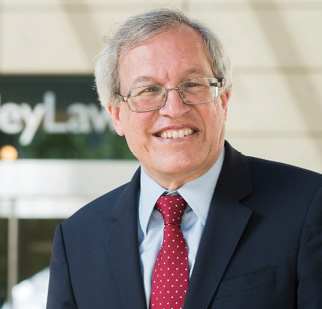 Erwin Chemerinsky. (Photo by Jim Block)
When the U.S. Supreme Court returns to hear the first oral arguments of the term Monday, it will be with the same nine justices as it has had the past five years.
There was much speculation that Justice Clarence Thomas or Justice Samuel Alito might retire over the summer to allow President Donald Trump to name their successors with a Republican-controlled Senate.
The reality is that if the Democrats take control of the Senate after the November elections, no one President Trump nominates has a chance of confirmation. The Democrats are sure to follow the Republicans’ example of blocking President Barack Obama’s nomination of D.C. Circuit Chief Judge Merrick Garland.
Before going on their summer recess, the justices had granted review in 25 cases to be heard during the October 2026 term. They added another case over the summer. These are the matters to be decided after briefing and oral argument and do not include the many matters pending on the Supreme Court’s emergency (“shadow”) docket.
The court decided 58 cases with signed opinions after briefing and oral argument last term and 56 cases in the term before that. This means that slightly less than half the docket for the term is set. The court will continue to take cases through mid-January to be decided by the end of June.
What are some of the likely most important cases?
Environmental protection
The question presented in Suncor Energy (U.S.A.) Inc. v. County Commissioners of Boulder County is “whether federal law precludes state-law claims seeking relief for injuries allegedly caused by the effects of interstate and international greenhouse gas emissions on the global climate.” The court also added a question: whether it has statutory and Article III jurisdiction to hear this case.
(Justice Samuel Alito recused himself from the case Monday.)
The County Commissioners of Boulder County and the City of Boulder sued Exxon Mobil Corp. and three Suncor Energy entities in Colorado state court, seeking damages for the role that the companies’ production, promotion, refining, marketing and sale of fossil fuels allegedly played in exacerbating climate change and thereby harming Boulder’s property and residents. Boulder brought tort claims alleging that the companies knowingly contributed to climate change while misleading the public about the dangers of their products. Boulder further alleges that it has incurred and will incur millions of dollars in costs to protect against climate impacts such as wildfires, flooding and drought. Boulder does not seek to enjoin any oil and gas operations or sales, and it does not seek to enforce emissions controls of any kind.
The Colorado Supreme Court ruled that Boulder’s claims are not preempted by federal law and remanded the case, expressing no opinion on the ultimate viability of the merits. The court explained that the federal Clean Air Act contained no express preemption provision. Also, the court said that there was no field preemption because the act does not occupy the field of emissions regulation and, in fact, contains two savings clauses preserving stricter state standards and common-law rights. And there was no conflict preemption because compliance with both the act and state tort law is possible; and Boulder’s damages claims, which do not seek to regulate emissions, pose no obstacle to the act’s purposes.
Interestingly, the petitioner energy companies’ primary argument is that the Constitution denies to the states the ability to regulate pollution because of its interstate nature. The petitioners write: “Instead, the structure of our constitutional system continues to foreclose resort to state law unless Congress affirmatively authorizes its application. States have no residual or inherent power under our Constitution to regulate in this area, and no federal law authorizes state common-law claims for harms caused by diffuse interstate and international emissions.” If the Supreme Court accepts this argument, it will have a dramatic effect in lessening the ability of states to regulate pollution.
This is one of many civil cases that have been brought against major oil companies for their role in contributing to climate change. It is the first to make it to the Supreme Court.
Guns
The issue in Viramontes v. Cook County is “whether the Second and 14th Amendments guarantee the right to possess AR-15 platform and similar semiautomatic rifles.”
In District of Columbia v. Heller in 2008—the first Supreme Court case to declare a law unconstitutional for violating the Second Amendment—the court was explicit that the Second Amendment is limited to a right to possess “the sorts of weapons … [that] were ‘in common use at the time.’” The court said that this “limitation is fairly supported by the historical tradition of prohibiting the carrying of ‘dangerous and unusual weapons.’”
No one can say that AR-15 weapons existed in 1791, let alone that they were in common use. Nor can it be plausibly denied that they are very dangerous weapons. This is the weapon that has been used in many of the most tragic mass shootings in the United States, including the 2012 Sandy Hook Elementary School shooting, the 2015 San Bernardino attack, the 2017 Las Vegas shooting, the 2017 Sutherland Springs church shooting, the 2018 Marjory Stoneman Douglas High School shooting and many other mass shootings.
The court has been very protective of Second Amendment rights in recent years. Will it extend to protecting a right to have this very dangerous weapon?
Religion
The Supreme Court returns to the application of the free exercise clause of the First Amendment in St. Mary Catholic Parish v. Roy. Colorado’s Universal Preschool Program funds preschools—public, private, and religious alike—that sign an agreement to give children an “equal opportunity to enroll” regardless of, among other things, religious affiliation, sexual orientation or gender identity. Two Catholic parish preschools and the Archdiocese of Denver say that they have a religious belief that they must consider a family’s sexual orientation and gender identity in admissions, and they sued under 42 U.S.C. § 1983 for an injunction against the requirement.
In Employment Division, Department of Human Resources of Oregon v. Smith (1990), the Supreme Court held that the free exercise clause cannot be used to challenge a neutral law of general applicability. That is, if the law is not motivated by a desire to infringe religious freedom and if it applies to everyone, it cannot be challenged as violating free exercise of religion—even if it substantially burdens religious conduct. In Fulton v. City of Philadelphia (2021), the court ruled that a law is not of “general applicability” if government officials have discretion to create exemptions, even if they never have done so. Three justices—Alito, Thomas, and Neil Gorsuch—called for Employment Division v. Smith to be overruled. Justice Amy Coney Barrett wrote an opinion, joined by Justice Brett Kavanaugh, expressing support for that view but saying that there were many difficult questions, and the court did not need to answer them to decide the case before it.
In St. Mary Catholic Parish v. Roy, the Denver-based 10th U.S. Circuit Court of Appeals upheld the Colorado law, concluding that it was a neutral law of general applicability. The case presents the Supreme Court with the opportunity to clarify both when a law is of general applicability and when conditions on funding that touch upon religious beliefs violate the First Amendment. It is in the context of a court where at least three, and perhaps five, justices want to dramatically change the law by overruling Employment Division v. Smith.
Standing
In International Partners for Ethical Care Inc. v. Ferguson, the court will consider standing in a particularly controversial social context. A Washington state law allows health care providers to provide mental health care to those age 13 and older without parental consent. The Supreme Court granted certiorari on the question: “Whether parents have Article III standing to challenge a law or policy that deliberately displaces their decision-making role as to ‘gender transitions’ of their children, and in so doing creates present and likely future impediments to their ability to parent.”
Two advocacy organizations and five sets of parents whose children have shown signs of gender dysphoria brought due process, free exercise and free speech challenges, alleging that fear of the statutes has altered their parenting, chilled their speech about gender and limited their access to information about their children. The district court found the alleged harms rested on a “speculative chain of possibilities” and dismissed the case for lack of standing.
The San Francisco-based 9th U.S. Court of Appeals affirmed the dismissal of the case. The court explained that the parents’ altered parenting was a self-inflicted injury: Plaintiffs “cannot manufacture standing merely by inflicting harm on themselves” out of fear of hypothetical future harm, and no plaintiff “can be heard to complain about damage inflicted by its own hand.” The court explained that no plaintiff alleged that their or their children’s conduct had yet brought them within the statutes’ reach; their injuries flowed from voluntary responses to the statutes, not from anything the statutes require.
In the past two terms, the court has been unsympathetic to the rights of transgender individuals. And in a matter on the emergency docket, Mirabelli v. Bonta in March 2026, the Supreme Court blocked a California policy that prohibited public schools from disclosing a student’s gender identity to parents without the student’s consent. In this context, International Partners for Ethical Care Inc. v. Ferguson likely will be a significant case about standing, though its context could very much affect how the justices see the jurisdictional issue.
Conclusion
These, of course, are just a few of the high-profile cases to be heard in the October 2026 term. And it is safe to predict that there again will be many that involve challenges to the actions of President Trump. It is sure to be another blockbuster year in the Supreme Court.
Erwin Chemerinsky is dean of the University of California at Berkeley School of Law. He is an expert in constitutional law. He’s also the author of many books, including his most recent ones: Campus Speech and Academic Freedom: A Guide for Difficult Times and The Supreme Court October Term 2024: Taking Sides.
This column reflects the opinions of the author and not necessarily the views of the ABA Journal—or the American Bar Association.