What are some good prompts when using AI for legal writing? Bryan Garner has some thoughts


The least useful prompt is: “Write this brief,” according to Bryan Garner. (Image from Shutterstock)
Bret Stephens, the Pulitzer Prize-winning New York Times columnist, recently pleaded with readers: “Never Write With A.I.” His argument isn’t frivolous. Writing makes thought clearer, more rigorous and more accountable. Surrender too much of the writing, and you’ll surrender some of the thinking with it. But lawyers should think about the technology differently.
A clerk at your elbow
Let’s clear away the foolishness.
AI isn’t a license to file fictitious authorities, sign briefs you haven’t read or launder machine-made prose as legal analysis. That isn’t innovation. It’s professional negligence.
Used properly, AI does the opposite: It keeps the lawyer in command while making the work quicker, tougher and better.
The closest analogy is a U.S. Supreme Court clerk at your elbow: astonishingly well-read, relentlessly available and capable of an extraordinary turnaround.
Starting with a lawyer’s prompt, a capable AI system can identify competing principles, surface factual and doctrinal uncertainty, expose unstated assumptions and explain why a legal question is difficult. But it needs a lawyer to supply context: the jurisdiction, procedural posture, governing law, factual record, audience, client’s objectives, commercial realities and strategic constraints.
A poorly considered prompt yields a thin response. A well-framed prompt forces you to identify what actually matters.
AI can be wrong. It can miss a controlling distinction, misunderstand procedural posture, turn an inference into a fact or produce authority that sounds plausible but doesn’t exist. You can’t pass the buck. It’s your work. Stand behind every proposition that leaves your office.
That’s why the clerk analogy is so apt. A clerk doesn’t relieve a judge of judgment. A clerk makes more judgment possible.
Law’s urgent prose
Law is the most practical of literary professions. Lawyers make things happen with words.
A contract allocates risk. A statute changes conduct. A letter preserves a claim, waives a right, starts a negotiation or starts a lawsuit. A motion frames the requested relief; a brief gives the court both a reason and a route to grant it. An ambiguous sentence can shift millions of dollars. A careless word can determine whether a client owns a right, assumes a duty or gives away an argument.
And time isn’t merely money in law. It can be leverage, remedy, evidence, jurisdiction and survival.
A memorandum that reaches the client after the board meeting is a scholarly artifact. A brief filed late is a professional blemish—and perhaps the beginning of a malpractice suit. A deal lawyer who spots the fatal indemnity problem after signing has made a discovery, but it’s nothing but anguish.
That’s why AI’s speed matters. It can test a brief’s organization, identify inconsistently used defined terms in a lengthy agreement, generate a chronology from a disorderly file, or pressure-test an argument before it goes to the partner.
The real benefit isn’t simply speed. It’s time gained for work that requires judgment: reading the cases, checking the record, counseling the client and deciding what should be done.
Large firms can deploy associates, paralegals, librarians, subject-matter specialists and trusted editors. Solo and small-firm lawyers usually have fewer of those resources. Used skillfully, AI can narrow the gap by supplying a tireless first reader—one that can summarize a wordy passage, compare formulations, identify ambiguity, flag weak transitions and unsupported assertions, and expose problems before the work reaches a client, partner, opposing counsel or judge. It won’t and can’t replace experience or judgment. But it can give smaller practices editorial and analytical support once available chiefly to lawyers backed by a large-firm apparatus.
AI doesn’t reduce expertise to a commodity. It gives expertise a powerful new tool in its belt.
Better questions
The least useful prompt is: “Write this brief.”
Better prompts sound like questions from an exacting partner, sharp opponent or excellent clerk:
- State the strongest counterargument. Don’t invent facts or authority.
- Identify every place where this analysis assumes its conclusion.
- Does this memorandum state the governing rule before applying it?
- Propose a better sequence.
- Mark every factual assertion that needs record support.
- Find vague referents, shifting terminology, unexplained transitions, and overlong or imprecise sentences.
- Revise this passage three ways: one plainer, one shorter and one more formal.
- I need to cut 1,000 words from this brief. Give me a version with every cuttable word and sentence in boldface so I can decide.
- Read this as a judge with limited time and no desire to rescue my argument. What will you find unpersuasive?
Those prompts don’t evade thinking. They require it.
You must decide what question to ask, supply the relevant material, assess the answer, verify the authorities, and decide whether the proposed change improves the work. The machine can generate possibilities. It can’t assume responsibility for choosing among them.
Writing remains one way lawyers discover thought. The troublesome sentence often reveals the troublesome idea.
Teaching the skill
Some law schools have responded to AI with strict limits. The University of California at Berkeley School of Law’s default policy, effective in summer 2026, bars students from using AI to conceptualize, outline, draft, revise, translate or edit work submitted for academic credit. It also bars AI use for any purpose during examinations. That’s understandable. Before students can supervise a tool, they must learn to do the underlying work: read closely, analyze independently, formulate rules, distinguish precedents, organize arguments and produce a coherent first draft. A lawyer who can’t do those things unaided can’t reliably tell whether AI’s help is sound.
But total prohibition carries a cost. New lawyers are increasingly expected to use AI, yet many arrive in practice wary of it after years of warnings about its dangers and unskilled in its reasonable use.
I saw the problem this year when I required my own law students to use AI—not as a ghostwriter or answer machine, but as a critic and rigorous reviser.
They used it to test an argument’s structure, solicit counterarguments, uncover ambiguity, compare formulations, cut excess and sharpen prose.
The distinction is crucial. Ask AI to write an answer, and you may receive polished language without learning much about the problem. Write the answer yourself, then ask the machine to attack your reasoning, and you face a different exercise altogether: You must decide whether the criticism is right.
Law schools should teach both independent analysis and technological mastery. The first guards against dependence; the second, against obsolescence.
The mirror problem
One student’s final examination supplied the clearest lesson. He wrote that AI had been used for background only, not for composition or editing. But the answer also suggested that he hadn’t recognized how much the writing itself needed work.
Like many developing writers, he lacked a dependable sense of the distance between what he intended and what readers received.
That blindness afflicts legal writers at every level. You can mistake a long sentence for a nuanced one, an abstract sentence for an intelligent one, and an unexplained conclusion for an inevitable one. You may not see that the key argument is buried, the authority overstated, the verb mismatched with its subject, or the paragraph flailing aimlessly.
You know what the sentence is supposed to mean. That knowledge can become a kind of camouflage.
AI won’t cure that blindness on its own. Used badly, it can lacquer weak thinking in glossy, generic prose. Used well, it can expose the missing premise, weak transition, unsupported assertion, undefined term or passage intelligible only to its author.
For writers afflicted with pride of authorship—who isn’t?—a machine is an unusually painless critic. It has no wounded expression, no raised eyebrow and no need to preserve the friendship.
The New York Times’ Bret Stephens is right about the principle that matters most: Never surrender your mind to a machine.
But there’s no virtue in refusing the remarkable clerk who has appeared at your elbow. Interrogate it. Challenge it. Correct it. Reject it when necessary. A Supreme Court justice doesn’t become less of a judge because a clerk exposes a weakness in a draft opinion. Neither do you.
There’s also a practical consequence. Lawyers compete not only on judgment but on how quickly and economically they can exercise it. Give one lawyer a tireless clerk and deny one to another, and the difference will eventually matter.
AI won’t replace lawyers.
Lawyers who use AI effectively will replace lawyers who don’t.
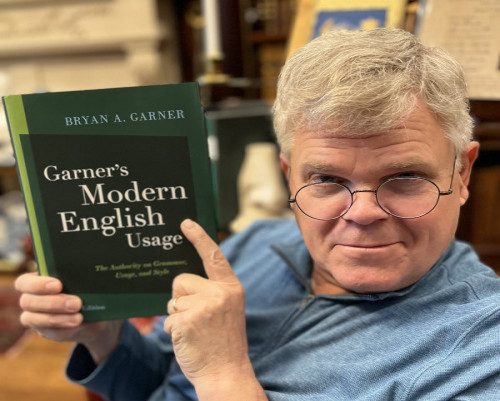
Bryan A. Garner. (Photo by Karolyne H.C. Garner)
Bryan A. Garner writes not only this column but also the “Garner the Grammarian” column in National Review. His most recent book is the seventh pocket edition of Black’s Law Dictionary.
This column reflects the opinions of the author and not necessarily the views of the ABA Journal—or the American Bar Association.