On the TV show Face the Nation in December, host Bob Schieffer asked Newt Gingrich how he would resolve his beef with so-called activist judges, including one in Texas who blocked prayer at a public school. The former House speaker responded that he would instruct U.S. marshals to arrest judges…
On June 26, 1973, the growing Watergate scandal was already a year old, and John W. Dean III, President Richard M. Nixon’s former White House counsel, was in his second day of testimony before the Senate Watergate Committee when Herman Talmadge, a Democrat from Georgia, directed his attention to exhibit 34-47.
“It is a list of all the people that you thought had violated the law and what the laws may be that they violated—is that correct?” the Georgia senator inquired.
“That is correct,” Dean responded. “My first reaction was: There certainly are an awful lot of lawyers involved here. So I put a little asterisk beside each lawyer.”
“Any significance to the stars?” asked Talmadge, referring to the asterisks.
“That was just a reaction of mine,” answered Dean. “How in God’s name could so many lawyers get involved in something like this?”
Forty years ago this month, five “burglars” wearing business suits and surgical gloves and toting electronic surveillance equipment were arrested inside the headquarters of the Democratic National Committee at the fashionable Watergate office complex in Washington, D.C.
The Nixon White House initially dismissed the break-in as a “third-rate burglary,” but after a year of increasingly persistent media coverage, Congress initiated multiple investigations that exposed the involvement of more than 20 of the most powerful lawyers in the United States.
Former FBI Special Agent Coleen Rowley didn’t exactly shout out “I told you so!” But she gloated when she scribbled it atop a blog account after officers caught and questioned the suspect in the attempted Times Square bombing. “After so many years of waiting and warning,” Rowley told the Huffington…
Law professors Norman Abrams of the University of California at Los Angeles and Christopher Slobogin of Vanderbilt University consider the legal dilemmas surrounding coerced interrogation of terrorism suspects. Their essays are part of a forthcoming book, Patriots Debate: Contemporary Issues in National Security Law. The book—edited by Harvey Rishikof, Stewart…
On an unusually warm March evening, “Alexander,” with lawyer Alexandra B. Hess by his side, talks about his journey through life so far. Less than two years ago and then 16, Alexander was hiding in the waters of the Rio Grande hoping the U.S. Border Patrol did not see him.…
In 2005, Chloe Gilgan bet that obtaining a law degree would guarantee her a competitive salary and a steady career path. Instead, she wound up with a mountain of debt and limited job prospects. Gilgan, who says she relied heavily on placement data from New York Law School to decide…
A Catholic school art teacher who volunteers on Sundays to distribute communion might be allowed to file a discrimination action against her employer. But if the teacher also hands out communion at school Masses, that might change her status and allow the First Amendment’s ministerial exception to bar the complaint.…
Almost anyone who uses the Internet and is slightly curious about their own digital existence has, over the past decade, had what might be termed a Google moment. These are times, as you type your name into the search engine box, that you realize you don’t have control, that whatever you’ve done in your life is free to be appropriated and contextualized in all sorts of ways. We have identities, and then we have digital identities; and it’s not hard, when you’re looking through the digital looking glass of a Google ego surf, to wonder which is more important.
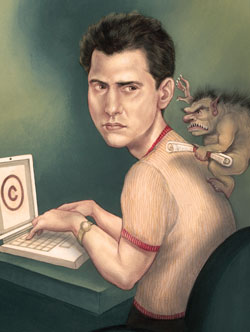
My strangest Google moment came one day last year when Google’s search engine monkeys led me to an article in the Las Vegas Sun revealing that I had just been sued. The plaintiff in the lawsuit was Righthaven, a company founded in early 2010 with the express purpose of suing copyright infringers on the Internet.
I’ve written about this company just once before, in a December 2010 article for Ars Technica that revealed that the company had picked a new target—the Drudge Report. My article included an image from Righthaven’s legal papers of a picture the company claimed to own. For this copy of a copy of a copy, I became Righthaven’s latest mark.
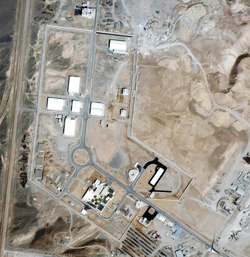
Near the Iranian village of Natanz, lying by the nation’s Karkas mountain range, a compound of tan-colored, block-shaped buildings sprawls with in a 25-acre enclosure. In a complex 25 feet underground, encased by walls 8 feet thick, 5,000 centrifuges churn out enriched uranium as they spin at almost 100,000 revolutions…
Washington, D.C., attorney Stewart A. Baker and Charles J. Dunlap Jr., a former deputy judge advocate general of the U.S. Air Force, debate whether the U.S. should learn the practicalities of winning a cyberwar—and then ask lawyers for their input—or, instead, set the legal ground rules before conducting cyberwarfare in…