Chemerinsky: Supreme Court once again examines conflicts over the free exercise of religion


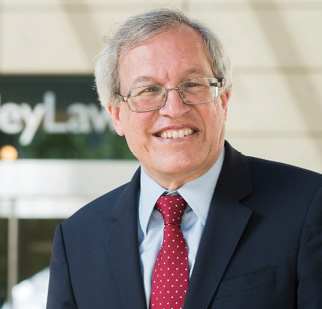 Erwin Chemerinsky. (Photo by Jim Block)
On Tuesday, the U.S. Supreme Court will hear oral arguments in a major case about free exercise of religion, St. Mary Catholic Parish v. Roy. Over the last decade, the justices have greatly expanded First Amendment protections for religion. This case could either go much further in that direction or show a court that is willing to allow the government to stop discrimination even when it infringes on religious beliefs.
Facts
The case involves a Colorado law launched in 2023 that provides for universal preschool education. Under the program, the state will pay for preschool at any public, secular private or religious school. To receive funds, the school must agree that it will not discriminate against children based on their parents’ race, ethnicity, religion, sexual orientation, gender identity, disability, income or lack of housing.
St. Mary Catholic Parish in Littleton, Colorado, and another Catholic preschool in the Archdiocese of Denver declined to sign the agreement, saying that it conflicts with church teachings on marriage, sex and gender. Their objection is to having to agree to take children whose parents are gay, lesbian or transgender. They argue that excluding the religious schools from the universal program denies them a public benefit due to their religious beliefs.
The federal district court and the Denver-based 10th U.S. Circuit Court of Appeals rejected their challenge and upheld the Colorado law. Both courts relied on the Supreme Court’s decision in Employment Division v. Smith (1990), which held that the free exercise clause of the First Amendment cannot be used to require exceptions from general laws. That case involved Native Americans who sought an exemption from an Oregon law prohibiting the consumption of peyote on the grounds that its use was a part of their religious rituals. Justice Antonin Scalia wrote the opinion for the court ruling against the Native Americans. The court said that so long as the law was neutral, not motivated by a desire to infringe religion, and so long as it applied to everyone, it could not be challenged as denying free exercise of religion.
The federal district court and the 10th Circuit upheld the Colorado law prohibiting discrimination by preschools, concluding that it was a neutral law of general applicability. These courts also held that there was no discrimination against religious schools in their ability to receive public funds. In a series of cases—Trinity Lutheran v. Comer (2017), Espinoza v. Montana Department of Revenue (2020), and Carson v. Makin (2022)—the court held that it violates free exercise of religion for the government to deny funds to religious schools that it provides to private secular schools. The Colorado law was upheld because it does not discriminate against religious schools; it provides funds to faith-based preschools on the same terms as all other preschools.
The plaintiffs sought certiorari, and the Supreme Court granted review on two questions. (1) Whether proving a lack of general applicability under Employment Division v. Smith requires showing unfettered discretion or categorical exemptions for identical secular conduct; (2) whether Carson v. Makin displaces the rule of Employment Division v. Smith only when the government explicitly excludes religious people and institutions.
The application and future of Employment Division v. Smith
The last major Supreme Court decision concerning the application of Employment Division v. Smith was Fulton v. City of Philadelphia (2021). The city of Philadelphia contracts with private social service agencies to help place children in foster homes. Every contract is explicit in prohibiting the agency from discriminating on the basis of race, sex, religion and sexual orientation.
Catholic Social Services long had participated in this aspect of the program but in recent years has declined to do so because of the contractual requirement that it not discriminate based on sexual orientation. CSS says that its religious beliefs prevent it from providing inspections or placing children with same sex-couples.
The agency challenged the nondiscrimination requirement as violating its First Amendment rights. The district court and the Philadelphia-based 3rd U.S. Circuit Court of Appeals rejected these arguments. Both courts relied on Employment Division v. Smith.
The Supreme Court unanimously reversed the lower courts and ruled in favor of Catholic Social Services. Chief Justice John Roberts wrote the opinion for the court. He said that under Employment Division v. Smith a “law is not generally applicable if it ‘invite[s]’ the government to consider the particular reasons for a person’s conduct by providing a ‘mechanism for individualized exemptions.’” The Philadelphia ordinance gave city officials the authority to grant exceptions to the nondiscrimination requirement. The court said that it was irrelevant that none ever had been granted and that there was no evidence of discrimination against religious entities. The existence of discretion was enough for it to not be a neutral law of general applicability. Therefore, it had to meet strict scrutiny. The court concluded that the city failed to meet strict scrutiny and that its policy was therefore unconstitutional.
Justice Samuel Alito concurred in the judgment and was joined by Justices Clarence Thomas and Neil Gorsuch. In a 77-page opinion, Justice Alito expressly called for the court to overrule Smith. Justice Alito argued at length against the Smith approach and stated: “We should reconsider Smith without further delay. The correct interpretation of the free exercise clause is a question of great importance, and Smith’s interpretation is hard to defend. It can’t be squared with the ordinary meaning of the text of the free exercise clause or with the prevalent understanding of the scope of the free-exercise right at the time of the First Amendment’s adoption.”
Justice Amy Coney Barrett wrote a concurring opinion that was joined in full by Justice Brett Kavanaugh. She expressed agreement with many of the criticisms of Smith advanced by Justice Alito. But she said that there are hard questions as to what test should replace the one from Smith. She said that the court did not need to address that in this case because the city of Philadelphia policy was unconstitutional “regardless whether Smith stays or goes.”
The Supreme Court did not grant certiorari in St. Mary Catholic Parish v. Roy on the question of whether to overrule Employment Division v. Smith, but that issue very much underlies the issues before the court.
Petitioner St. Mary’s Catholic Parish clearly is urging the court to jettison Smith. The first argument in its brief is that the “court rarely applies Smith.” It says: “Out of the 18 free exercise cases this court has resolved since Smith in 1990, this court has relied on Smith only twice to rule against the religious objector,” and one of these was Smith itself.
There also is the underlying question of whether a religious belief should be a basis for an exemption from antidiscrimination laws. In Newman v. Piggie Park Enterprises Inc. (1968), the court summarily rejected a claim that a person’s religious beliefs were a basis for their discriminating in violation of civil rights statutes. If the court overrules Smith, or says that strict scrutiny should be used under Smith, the question will need to be addressed: Should free exercise of religion provide a right to harm others by discriminating against them?
The denial of funding
For decades, the Supreme Court decided cases about when government aid to religious schools violated the establishment clause of the First Amendment. But over the last decade, the court has held that the denial of funding to religious schools when it is provided to private secular schools violates the free exercise clause of the First Amendment. For example, in its most recent ruling, Carson v. Makin (2022), the court held that it violated free exercise of religion for the state to pay for secular private schools but not religious schools for children in rural areas where there are not public schools.
The district court and the 10th Circuit upheld the Colorado law on the ground that it provided aid to all preschools—public, secular private, and faith-based—on exactly the same terms. But St. Mary’s Catholic Parish argues that Colorado is denying it funding because of its exercising its religious beliefs and excluding children whose parents are gay, lesbian or transgender.
In the prior cases about funding, the state laws expressly excluded religious schools. The Colorado law does not do that. Is it enough for a free exercise violation that its effect is to deny funding to schools that have a religious basis for their discrimination based on sexual orientation or gender identity?
Conclusion
In recent years, the conservative majority on the Supreme Court has greatly lessened the protections of the establishment clause of the First Amendment while simultaneously significantly increasing the safeguards under the free exercise clause. It has shown support for those who want to violate anti-discrimination laws on account of their religious beliefs. St. Mary Catholic Parish v. Roy will be important in indicating whether the court will go even further in these directions.
Erwin Chemerinsky is dean of the University of California at Berkeley School of Law. He is an expert in constitutional law. He’s also the author of many books, including his most recent ones: Campus Speech and Academic Freedom: A Guide for Difficult Times and The Supreme Court October Term 2024: Taking Sides.
This column reflects the opinions of the author and not necessarily the views of the ABA Journal—or the American Bar Association.