Bar association helps young lawyers refine business etiquette skills


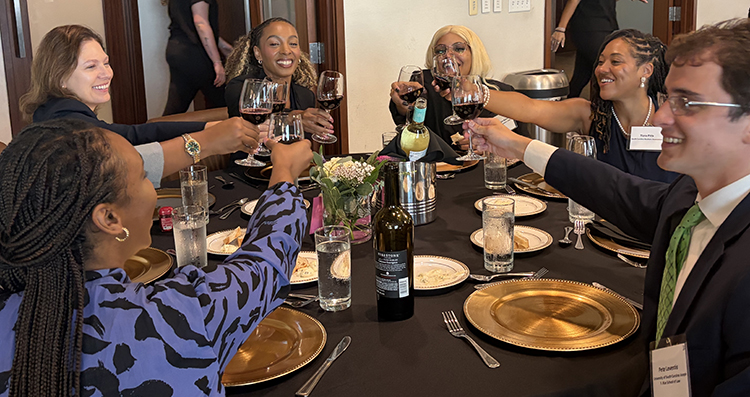
For the past six years, Kate Mills has represented a wide range clients in complex commercial disputes, including insurance matters, intellectual property disputes, professional negligence, and many others. Each practice area brings its own unique challenges. Another challenge that she’s faced? Learning how to hold a plate, a wine glass and a napkin while shaking someone’s hand at the same time.
“You put the plate between your bottom two fingers, and the wine glass you hold with your top two fingers and rest it on top of the plate. And your napkin is underneath,” says Mills, an associate at Adams & Reese in Columbia, South Carolina.
“You have to see it in real life,” adds Mills, the co-chair of Dinner with Decorum, the Richland County Bar Association’s newest event aimed at lawyers who have been practicing for 10 years or less. Offered for free July 9, it attracted 40 local young lawyers and 10 law students who learned how to navigate networking events and formal client dinners.
The idea arose after Shannon Bobertz, the president of the Richland County Bar Association in Columbia, heard through the ABA Bar Leadership Institute about a similar program organized by the Connecticut Bar Association. She is focusing this year on engaging young lawyers and wanted to give them the opportunity to access not just dining etiquette but high-level, corporate etiquette.
As part of Dinner with Decorum, attendees participated in a seated, multiple-course dinner and four sessions on circulating at a reception, holding conversations, proper dining rules and leaving a lasting impression. They included how to exit a discussion without being rude, techniques for remembering names, and how to navigate difficult foods without attracting attention. They also touched on how to follow up with the host of a dinner or event.
Anna Mills Polatty Cox, the founder of Amplified Communications, who has a certificate in corporate etiquette consulting, facilitated the event for the bar association.
“We had gazpacho as our first course, and one of the people raised their hands and said, ‘I’m not clear which spoon to use for my soup,’” says Bobertz, the chief of staff for the South Carolina Department of Natural Resources. “You could ask real-time questions, and no one was shaming anyone or judging anyone.”
A major impetus for the event was to support young attorneys who attended law school or began their legal careers during the COVID-19 pandemic, when they weren’t able to participate in networking events and hone their business etiquette skills, says Mandy Wren, the executive director of the Richland County Bar Association.
She says it also intended to help first-generation lawyers, who may not have as much experience with etiquette as some of their peers.
“Confidence building is the biggest thing that comes to mind,” Wren says. “If you weren’t in a family or a setting where this was commonplace, I would hate for anyone to feel that they were lesser because they didn’t know some of it.”
“This was an opportunity to either learn or polish your existing knowledge of etiquette and business etiquette in a professional legal setting and to feel confident about it,” she adds.
Mind your manners
Because the South Carolina Bar prides itself on being well-mannered, the Richland County Bar Association also wanted to reach lawyers who might not have colleagues who can teach them about etiquette, Mills says. The event was free to remove financial barriers, she also says.
“We wanted to make it something that everyone could attend no matter your background and just be a good opportunity to ask those questions that might not be one of the most natural things to ask another attorney or co-worker,” Mills says.
Bobertz, who attended Dinner with Decorum with the bar association’s other executive committee members, noticed that nearly everyone at her table was a first-generation lawyer. She says they all remarked that they learned at least one thing that they didn’t already know.
“But I will tell you, even seasoned lawyers, when I told them about this, they said, ‘Why are you just doing it for young lawyers? I think I could use some practice with this,’” Bobertz says.
The event, which was hosted at Nelson Mullins Riley & Scarborough in Columbia and co-chaired by law firm associate Morgan Spires, was attended by a diverse group of lawyers, Bobertz adds. This included members of the public defender’s office and the solicitor’s office; federal prosecutors; in-house counsels; and lawyers from large, small and solo firms.
Mills left Dinner with Decorum with another tip that she won’t soon forget—where to wear your nametag. She learned that it goes on your lefthand side, so that when you shake with your right hand, you don’t cover up your name.
“It’s something you might not think of as a young lawyer, but when meeting a seasoned attorney or politician or someone who has been in this world for a long time, it’s something they will notice, and you might not even know you just got a ding,” she says.
Write a letter to the editor, share a story tip or update, or report an error.