Lawyers often take on additional work beyond the boundaries of their practices. But some attorneys take parallel paths, excelling in another areas completely unconnected to law. These mega-multitaskers have essentially built second careers—making money, gaining recognition, building brands and reporting a level of satisfaction they think wouldn’t be possible working in law alone.
Anti-profanity laws remain on the books in some states. Such laws are sometimes considered constitutional under the fighting words doctrine—words the Supreme Court defined in Chaplinsky v. New Hampshire (1942).
Last summer, a group of academics organized a workshop about gerrymandering—the manipulation of political lines based on party, race or some other factor.
Such a workshop wouldn’t be uncommon or out of place at a law school or a college political science department. But the one at Tufts University was organized chiefly by mathematicians and with mathematical principles in mind.
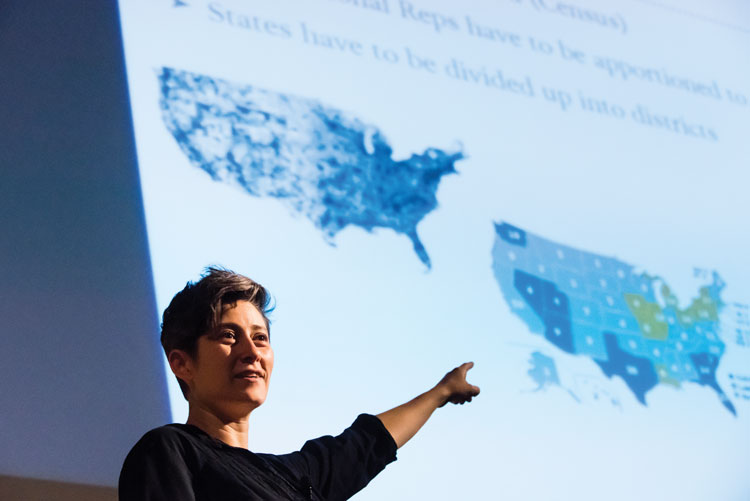
The “Geometry of Redistricting” workshop mixed math, law and civil rights, with seminars for would-be expert witnesses, teachers, lawyers and the general public. The goal? To create evidence-based solutions to the problem of gerrymandering.
The term gerrymandering dates to the early 19th century and has been the subject of U.S. Supreme Court cases going back decades with very little resolution of the issue. But there is a movement of mathematicians motivated by a brazen and self-confident idea: That mathematical principles can solve the riddle of unconstitutional gerrymandering. Now they just have to convince the courts.
Photo of Moon Duchin courtesy of Tufts University
“This isn’t mathematicians trying to liberate us from politics,” said Moon Duchin, an associate professor of mathematics at Tufts and a key organizer of the workshop, at the Aug. 7 opening. “This is mathematicians trying to be in conversation with politics.”
Justin Solomon, an assistant professor of electrical engineering and computer science at the Massachusetts Institute of Technology, told attendees, “It’s no secret with these redistricting problems that, at a very base level, it’s a geometric challenge. Somehow, at the end of the day, we have to draw shapes on a map.”
The question of what shapes, and how they are drawn, is at the heart of state and federal court cases across the country.
‘BLOCKBUSTER TERM' FOR GERRYMANDERING
Duchin and Solomon are among the founders of the Metric Geometry and Gerrymandering Group, a somewhat awkwardly named organization that put on the first workshop.
The August session could not have come at a more propitious time. It happened several weeks before the Supreme Court heard arguments in Gill v. Whitford, a Wisconsin case that was the first major lawsuit about partisan gerrymandering to be taken up by the justices in 14 years. The last big ruling on partisan gerrymandering was in Vieth v. Jubelirer (2004).
In Gill, the high court is reviewing a lower court’s decision striking down the state’s 2011 Republican-drawn redistricting plan for the Wisconsin State Assembly as a partisan gerrymander. The three-judge federal district court panel relied heavily on a mathematics-based test for undue partisanship in such plans called the “efficiency gap.” That test was developed by California political scientist Eric McGhee and University of Chicago law professor Nicholas Stephanopoulos.
But even as the justices privately deliberated about what course they would take in Gill after the October arguments, new cases continued to emerge.
“It is shaping up to be a blockbuster term on gerrymandering at the Supreme Court this term,” says Richard L. Hasen, a professor of law and political science at the University of California at Irvine and author of the authoritative Election Law Blog.
In December, the court announced it would hear arguments in another partisan gerrymandering case, Benisek v. Lamone, from Maryland. That case involves a challenge by voters to a 2011 congressional remap drawn by Democrats, which the plaintiffs claim resulted in a massive swap of Republican voters for Democratic ones in Maryland’s 6th Congressional District. The longtime Republican incumbent was ousted by a Democrat the next year.
“The fact that the Supreme Court agreed to hear a second one of these [partisan gerrymandering] cases means this is really the chance” to establish a standard for such claims, Hasen says.
Meanwhile, activity on partisan gerrymandering has been increasing in the lower courts. In January, a three-judge federal district court panel in North Carolina struck down that state’s congressional redistricting plan because it was drawn by Republicans “motivated by invidious partisan intent,” according to the opinion.
Also in January, a three-judge federal court panel in Pennsylvania, in a challenge to that state’s congressional remap, held 2-1 that no claims for partisan gerrymandering could be brought in federal courts under the elections clause in Article I of the U.S. Constitution.
(Most of the other partisan gerrymandering claims have been based on the First Amendment’s speech and association rights or the 14th Amendment’s equal protection clause.)
Meanwhile, the Pennsylvania Supreme Court struck down the Republican-led state legislature’s congressional remap based on partisan gerrymandering that the court found to violate the state constitution. The state’s highest court ordered that a new map be drawn for this year’s elections. Justice Samuel A. Alito Jr., acting as a circuit justice for the federal circuit covering Pennsylvania, declined a request from Republican lawmakers to stay the order.
And back at the Supreme Court, which has had a steady diet of racial gerrymandering cases in the past 20 years, the justices agreed in January to take up a major racial gerrymandering case from Texas. It involves challenges to remaps for the state’s congressional districts and the lower house of its legislature.
“The advantages for women in the human rights field are that the employers tend to pay greater attention to issues of equality, it can contribute to a sense of self-worth and there is often good camaraderie,” says Brittany Benowitz, director of the Justice Defenders Program for the ABA Center for Human Rights.
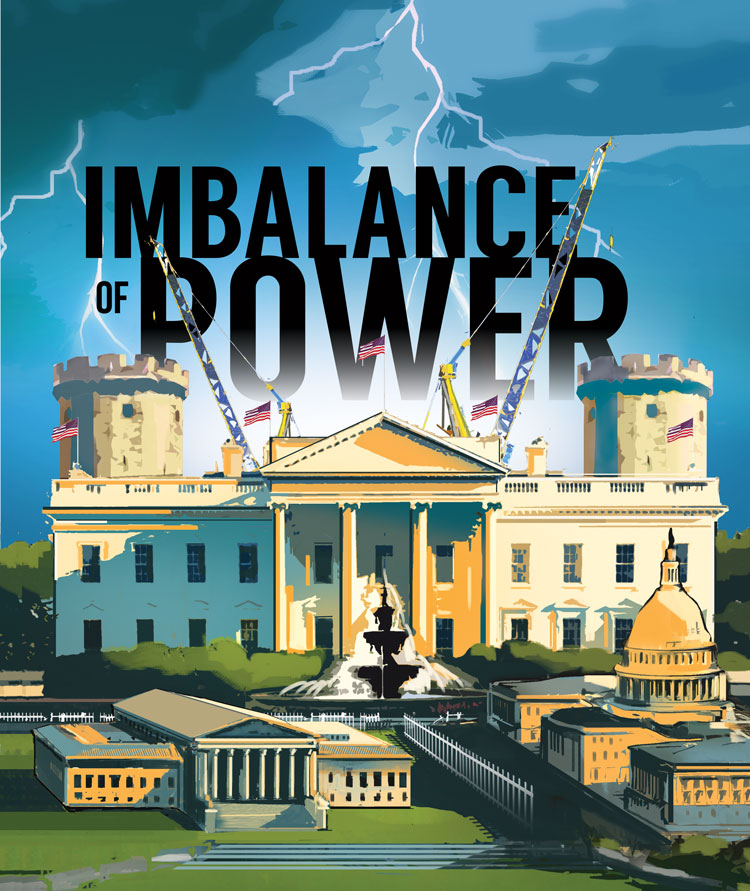
While President Donald Trump’s brash style and bold actions in dealing with the other branches of government have made the study of the separation of powers popular again, the greater concern is a more subtle balance of powers within the executive branch—the level of independence accorded the Department of Justice.
When President Donald Trump was elected with what he saw as a mandate to shake things up, the stolid study of constitutional law suddenly became operatic, including the political doctrine of the separation of powers. Aspects of it are now dramatic topics, sometimes even on the street in a fashion, though only a quarter of Americans can name the three branches of government.
State freedom of information laws are intended to allow citizens to keep tabs on their governments. While they expose wrongdoing, mismanagement, reckless spending and even scandal, they also can be abused.
Although reformers say an algorithm called a risk assessment decreases crime rates, reduces jail populations and increases government savings, the bail bond industry sees a permissive tool that is bad for public safety and an existential threat.
In a comparison of six legal databases—Casetext, Fastcase, Google Scholar, Lexis Advance, Ravel and Westlaw—when researchers entered the identical search in the same jurisdictional database of reported cases, there was hardly any overlap in the top 10 cases returned in the results.