Governors' races in Colorado, Michigan put former law deans on ballot


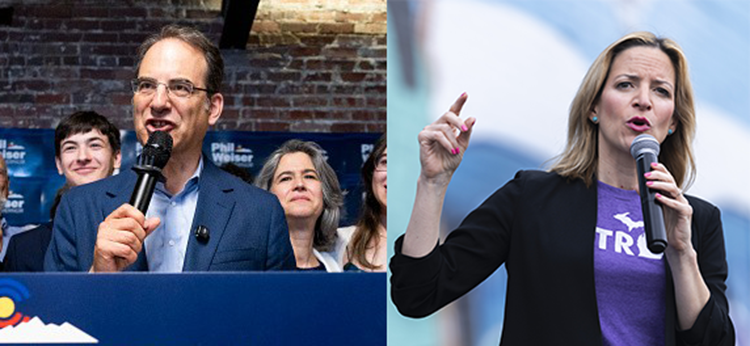
Next month, voters in Colorado and Michigan will decide whether a former law dean should be elected governor of their respective states.
Schooled in leadership while running law schools, both Phil Weiser and Jocelyn Benson, running in Colorado and Michigan, respectively, receive high marks from former colleagues. Faculty who worked with the two gubernatorial candidates, now sitting in elected positions in their respective states, praised their former deans for their leadership styles, skills handling budgetary issues and knowledge of the law.
Weiser, who served in the top post at the University of Colorado Law School from June 2011 to July 2016, is Colorado’s Democratic candidate in the race against Victor Marx, a Republican, and Greg Lopez, an independent.
Benson, a Democrat in Michigan facing off against Republican U.S. Rep. John James, was dean of the Wayne State University Law School from 2014 to 2016.
“Being a dean is a hard job. There’s always going to be a few feathers ruffled,” says Harry Surden, a Colorado Law professor.
Colorado
Weiser, currently Colorado’s attorney general, is a law and policy expert who founded Colorado Law’s Silicon Flatirons Center for Law, Technology and Entrepreneurship.
“He was an outstanding dean, and he had great leadership, really good visionary for the law school,” Surden says, adding that Weiser “was broadly liked” and “a really good person who has a good heart. That’s a rare quality among politicians.”
He noted that Weiser managed the law school’s budget well at a time when other schools struggled. “The fiscal stewardship of the law school was terrific,” he adds.
Weiser worked for President Barack Obama’s administration, serving on the transition team overseeing the Federal Trade Commission, Surden adds. “He works with people from potentially different backgrounds or different political positions, something that will help him as governor.”
Weiser, who has written and taught about competition and innovation policy, led a bipartisan coalition of 39 attorneys general to persuade Congress to fund expanded access to broadband, Surden says. “He is one of the world’s leading technology experts on telecommunications law, antitrust law—really important issues,” he adds. “It’s a unique strength.”
One important issue that has emerged during the campaign relates to data centers. During a forum last week with the Republican opponent, Weiser said data centers in Colorado would need to meet criteria regarding clean water and protecting water along with utilities rates, according to the Denver Post, while Marx, who has positioned himself as a political outsider, said he favored an approach that would bring investment to Colorado and protect ratepayers.
“I do not want our state to fall behind in advancement of technology. It’s a great boost to our economy, but I believe in local control of what each county wants to do,” Marx said during the debate.
Lopez, the independent candidate, has questioned the costs involved with Weiser’s overall plans for the state at a September debate, according to Colorado Public Radio.
Michigan
Benson, currently Michigan’s secretary of state, became the youngest woman ever to lead a U.S. law school when she was chosen to become interim dean at age 36, according to the school’s website.
Benson was “easy to collaborate with” and “treated colleagues with respect,” says John Mogk, distinguished service professor at Wayne Law.
While at teaching Wayne Law, Benson specialized in election law and education law, also teaching courses on race and the law as well as sports and inequality.
As dean, she launched the law school’s Levin Center for Oversight and Democracy, where she still serves as vice chair of its advisory board. Her other initiatives included launching the Program for Entrepreneurship and Business Law, the Legal Advocacy for People with Cancer Clinic, the Civil Rights Clinic and an externship program, according to the school’s website.
“She’s a person who is willing to work day and night to achieve her objectives,” Mogk adds. “She’s taught the importance of the rule of law. She’s espoused the rule of law. She understands the importance of the separation of powers and the importance of bipartisanship and achieving the best results for government.”
Benson and James, the Republican candidate, clash on how to handle the tariffs imposed by President Donald Trump’s administration. In a debate last month, Benson said James has not pushed back on the tariffs, and that she had plans for “subnational” agreements with Canadian provinces that would protect goods between Michigan and Canada from the fees, according to Michigan Public Radio. But tariffs agreements are the sole purview of Congress, with states only allowed to join lawsuits that challenge their legality.
James has criticized her plans, calling them a distraction from more pressing issues like a gas tax, and has called for the Trump administration and Canada to get back to the bargaining table.
“Michigan will not be collateral damage in these negotiations,” James said in the September debate.
Mogk believes Benson is ready to “orchestrate good government,” Mogk says. “She’s going to be a good governor if the electorate decides to vote her into office.”
Attempts by the ABA Journal to contact Weiser’s and Benson’s campaigns, as well as their respective opponents, were not answered.
Write a letter to the editor, share a story tip or update, or report an error.